SoC provides image recognition for driver assistance
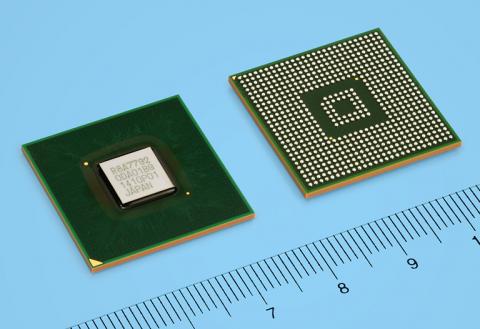
A system-on-a-chip (SoC) can implement image recognition technology to support high-resolution surround viewing in adas. The V2H is the first R-Car adas device from Renesas Electronics and includes additional functionality for higher performance, lower power and improved safety in traditional and emerging self-driving vehicles.
The company applied technology from its R-Car SoCs for automotive infotainment equipment and added image recognition and low-power consumption technologies. The device lets embedded system manufacturers deliver high-resolution surround-view monitoring systems, with multiple cameras, for point-of-view switching.
This includes rear-view and surround-view capabilities that expand what is seen by the system to every direction around the vehicle, aiding in driver oversight prevention. These types of systems demand higher processing performance to handle the expanded range of image recognition targets and increased processing load imposed by multiple cameras with higher pixel counts.
At the same time, there is demand for functional safety, to maintain high quality and performance, and reduced power consumption. Finally, the increasing cost of software development creates a need for better development efficiency.
“The R-Car V2H series delivers the imaging technologies, software tools and high-speed networking needed to develop robust adas systems that contribute to smarter, safer automobiles,” said Ryuji Omura, executive vice president at Renesas.
The SoC incorporates a core dedicated to viewpoint conversion, the Renesas IMP-X4 image recognition core and a 3D graphics core. The overall architecture is optimised to reduce memory bandwidth usage and overall latency.
Six IMR channels can each support a high-resolution camera where the combined output can produce high-definition surround view images. The IMP-X4, in combination with the CPU, provides the performance for real-time processing of image data as it is captured from the camera.
The 3D graphics core enables a human-machine interface that can deliver high visibility and easy identification of hazards, and supports texture mapping from the camera feeds. The design balances performance and power consumption, and there is a power cut-off function for the integrated cores; a DDR3-sdram provides power backup function.
The IMP-X4 incorporates six programmable image processing accelerators making possible image recognition functionality involving, for example, processing of input from multiple cameras, while altering their configuration as needed.
Library support has been expanded to include an open source library (Open CV), increasing the efficiency of software development for the user. The image recognition library does not require fine tuning to extract full performance from the image recognition core, delivering consistently stable performance and allowing for smooth software upgrades. In addition, the library is backwards compatible with the IMP series employed in the earlier R-Car H1 and SH7766 products, making it possible to reuse existing software resources.
Ethernet AVB provides features such as guaranteed bandwidth and synchronisation of multiple cameras. Also integrated are multiple-channel video codecs supporting up to five high-resolution cameras in parallel. For technical transition processing of video codecs for surround view monitoring systems, it supports MJPeg and H.264.
ECC has been implemented on external memory and CPU caches to support system manufacturers' safety concepts. Additionally, the hardware CRC functionality makes it possible to achieve end-to-end protection of data transfers. The early adoption of the Integrity real-time operating system from Green Hills Software is a step towards achieving functional safety in both hardware and software.
Samples will be available in September. Mass production is scheduled to begin in October 2016, and is expected to reach a combined production volume of 500,000 units per month by October 2017.
