Test & Measurement: On the move
Clive Davis, European marketing manager for Yokogawa Test & Measurement, shows how portable instruments can bring versatility to automotive testing
Today’s automotive engineers face challenges in two key areas. First is the detection and remedy of design and manufacturing issues, and particularly the need for fast identification of faults so remedies can be speedily implemented. Secondly, there is a need for performance and efficiency improvements in the propulsion and energy storage systems of electric and hybrid vehicles.
Both these challenges require laboratory quality instruments that can be used in the field to measure and record real-life operational situations.
To establish the types of measuring equipment that are required for testing power electronics systems, it is useful to look at the various stages in the development of a power electronics product.
Architecture and design
At the architecture and design stage, the key factors in the selection of a test instrument include fast inverter switching, high-frequency dynamic behaviour, overshoot on pulses and the need to trigger on individual waveforms.
Measurements of this type require an oscilloscope: ideally a mixed-signal instrument with multiple channels – eight is an ideal number to view input and output signals in three-phase systems.
Efficiency validation
Moving on to efficiency validation, the key factors required in testing an electric drive are power analysis, conversion efficiency, harmonic measurement, and the battery charge and discharge process.
For tests of this type, the instrument of choice is the power analyser, offering high precision, high accuracy, high stability and the ability to carry out calibrated measurements.
Insight and analysis
A deeper insight into an application requires the measurement and analysis of a combination of electrical, mechanical and physical signals and, in automotive applications, signals from buses such as Can and Lin. These results then have to be processed with various calculations being carried out to produce trend displays, which in turn are combined into a single measurement overview from which it becomes possible to find relationships and interactions between different parts of the drive system acting alongside one another.
For this type of measurement, providing a unique insight into the dynamic behaviour of a system, a relatively new class of instrument known as a scope-corder combines the features of an oscilloscope and a data-acquisition recorder.
Portability
Transferring the above types of testing from the laboratory to a production vehicle adds a number of challenges, specifically relating to portability and the availability of power in the field. Fortunately, these challenges have now been addressed with compact lightweight portable instruments. These allow automotive engineers to make more accurate and precise measurements, and record them over long periods of time.
They combine the features of a general-purpose oscilloscope and those of a high-performance data acquisition recorder in a single, portable instrument. Unlike alternative portable measuring instruments such as portable oscilloscopes and combined oscilloscope and multimeters, they add high levels of precision and accuracy to field measurements, isolated inputs for measurements at high voltage levels, and large-memory capabilities that allow long-term recording for many hours or even days.
Plug-in modularity
Another key feature can be plug-in modularity, which allows such an instrument to be configured to suit a variety of applications. This flexibility can be achieved by incorporating slots that can be populated with different types of user-swappable input modules.
This means, for example, that four isolated 16bit voltage inputs could be measured at speeds of megasamples per second (MS/s) alongside 16 temperatures or two separate Can or Lin buses each containing 60 signals. Changing a single module could enable measurement at 100MS/s with 12bit and 1kV of isolation. Meanwhile, some instruments have logic inputs always available, with even more available by swapping a further module. With a module that allows, for example, up to 5Gpoint of data per channel to be recorded directly to an SD card, the instrument could be used for continuous recording up to 50 days.
For example, units exist based on an A4-sized chassis and weighing 2.6kg excluding battery and under 4kg when populated with a battery and two four-channel modules. A built-in rechargeable battery provides three hours of continuous operation and can be combined with either mains or 10-30V DC power.
Engineers can have the choice of a simple level trigger or enhanced triggers on such things as pulse width and waveform period, and across multiple channels. For example, the wave window trigger is suitable for AC power-line monitoring, and enables voltage sags, surges, spikes, phase shifts or drop-outs to be captured for 40 to 1000Hz waveforms.
A Can monitor function can enable monitoring of Can frame data as trends. The trends can be displayed as waveforms, and compared with other analogue waveforms.
Applications
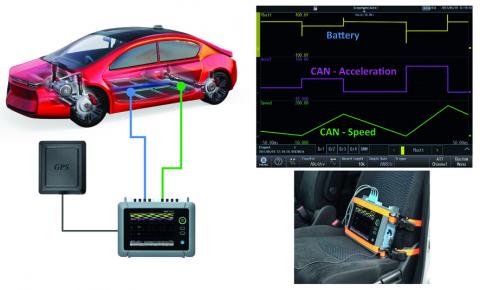
Several applications for such instruments have already emerged. In one example, a hybrid electric vehicle manufacturer is using one to check the performance of wireless charging circuits for electric vehicles. These vehicles will have to park in a specific place to interface with the charging circuitry, and the better the alignment of sender and receiver, the better the charging efficiency and its effect on the lifetime and performance of the battery. Using an optional GPS module to indicate the parking position, the unit monitors the variation in measured voltage and current during charging.
Using two instruments, the manufacturer can map the transmitter and receiver to correlate data from the complete charging process and battery system. Isolation technology renders it immune to the inaccuracies caused by the surrounding electrical systems, inverters and power supplies. Having a large memory and long duty cycle, it can record for the entire time it takes for the charging circuit to recharge the battery under test.
Another application has come from a motorcycle manufacturer which has chosen such an instrument not only because of its compact lightweight form factor and ability to attach easily for long-term durability testing but also because of the flexibility of the modular design that allows the instrument to be adapted to the test being carried out.
The manufacturer was previously using a more standard bench instrument but the motorcycle was difficult to ride and therefore it was hard to recreate authentic conditions to capture any anomalies. In addition, the test vehicle required further adapting to run different tests or multiple motorcycles for different tests.
Conclusion
Scope-corders allow engineers to see what precisely happens to automotive systems in the field in the real production environments rather than trying to simulate or emulate conditions in the laboratory or to build complex vehicle-mounted test rigs.
Clive Davis is European marketing manager for Yokogawa Test & Measurement
