V2X Communications: Safety First
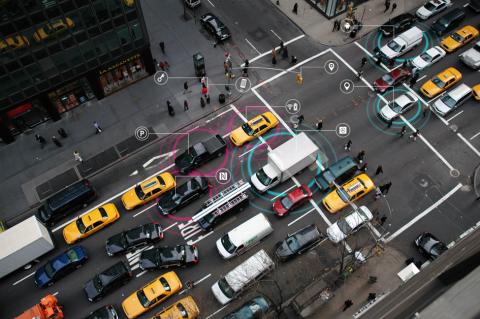
Thomas Hinz from NXP looks at how V2X can make driving safer and more efficient and create eco-friendly roads, but also make vehicles vulnerable to cyber attacks
Cars are becoming more intelligent. The integration of connectivity and mobile technology is making our vehicles more like super computers on wheels than a means of getting from A to B. Whether you drive a car, a van, a bus, a lorry or a mixture, pretty soon, that vehicle will be able to communicate with surrounding infrastructure such as traffic lights and road signs as well as other nearby vehicles.
This is known as vehicle-to-X (V2X) communications and provides 360˚ driver awareness that will result in safer, less congested and more environmentally friendly roads.
As vehicles become more aware of their surroundings, and their owners, they house an increasing amount of data and open up various gateways where it can be intercepted, or the car manipulated. Manufacturers and service providers need to make sure they place security at the heart of innovation to protect the physical safety of road users and pedestrians, as well as safeguard their personal information.
Improving safety
Statistics from the World Health Organisation suggest that a fatality is caused by a road accident every 25 seconds, and latest figures from the European Commission Directorate General for Mobility & Transport show there are 28,000 fatalities on European roads over the course of a year. With more than 90 per cent of all road accidents caused by human error, autonomous or semi-autonomous driving could save thousands of lives every year.
V2X communications – when a vehicle communicates with other vehicles (V2V) or the surrounding environment such as road signs (V2I) – are one of the key technologies already available to enable autonomous or semi-autonomous driving. For example, if equipped with V2X, a car would know if another vehicle up ahead had slammed on its brakes and can alert the driver accordingly to give them more time to slow down. Similarly, the car could also provide an advanced warning to the driver if it was approaching a smart road sign to advise of a hazard such as a slippery surface.
These alerts give the driver long enough to adapt their speed or driving style accordingly. In the future, fully autonomous cars might even adapt it for us, helping reduce road accidents further.
While fully autonomous vehicles may not be on the market for a while, e-call is already on its way to Europe and will be mandatory in all vehicles from April 2018. The technology sends an automatic alert to the emergency services in the case of an accident. It operates using chips installed into cars in the manufacturing process.
Data are transmitted via an internal sim card over cellular networks, including data such as GPS location, number of passengers, chassis number and direction of travel, directly to the European emergency number 112.
It is predicted to reduce the amount of time it takes emergency services to arrive at the scene of an accident by 50 to 60 per cent, saving around 2500 lives annually. With additional opt-in services, vehicles can also transmit information about possible causes of an accident such as potholes. This can then create alerts for other drivers via V2X and be fed back to maintenance teams for repair to prevent further incidents.
Easing congestion
V2X technology will not only contribute to safer roads, it will also help save the global economy billions by reducing congestion.
According to the World Health Organisation, the urban population has already grown 34 per cent since 1960. This is expected to accelerate by 2030. Together with rising GDP, this growth will drive a 50 per cent increase in the cost of congestion between 2013 and 2030, representing US$4.4tn across the USA and Europe according to the Centre for Economics & Business Research.
By communicating with each other, as well as surrounding infrastructure through V2X, cars become smarter and can share information about the current local traffic situation to optimise their routes. For example, each vehicle could transmit its average speed of a road segment to vehicles in the neighbourhood. Vehicles receiving this information can recalculate their routes based on the knowledge about the current possible speeds in the nearby road segments. This will in turn improve the traffic efficiency and help cities deal with the increasing amount of congestion as population grows.
Securely connected
As more vehicles leverage V2X to eliminate accidents, ease congestion and reduce emissions, they create new challenges for the industry. With more cars communicating wirelessly, vehicles open up gateways for car systems to be accessed and manipulated. For example, if hackers were to use an open gateway to access the V2X system, or related systems such as X-by-wire or adas, both of which are used in autonomous driving, that hacker could then manipulate the vehicle to slam on its brakes. If they hacked a number of vehicles on the same stretch of road, the impact could be huge. Reducing the risk to security caused by hacking is therefore critical to the safety of drivers, passengers and pedestrians.
Despite this, vulnerability to hacking is not covered in the main industry standards. ISO26262, for example, only determines automotive safety integrity levels for passenger cars and light utility vehicles based on the reduction of systematic failures, caused by human error, and random failures, caused by aging or thermal wear-out. Leading automotive manufacturers including Ford, GM, Nissan, Mazda, Honda, VW, Audi, Daimler, Hyundai Motor and Kia are now cooperating to drive common security approaches and standards.
The Camp (Crash Avoidance Metrics Partnership) consortium in America for example has been set up to build a secure system in cooperation with the US Department of Transportation. Camp has already spent several years researching and testing various security approaches. Similar initiatives are the Car 2 Car Communication Consortium (C2CC) in Europe and the ITS Connect Promotion Consortium in Japan.
Hacking doesn’t just present safety hazards, it also opens the automotive industry to both malicious data threats such as fraudsters stealing personal information to sell or forge identities, or non-malicious threats as can happen when drivers do not remove their data when a car is sold.
Systems such as e-call will need to house data about the vehicle itself, and will also have opt-in options of holding medical records of passengers to aid the emergency services when treating patients at the scene of an accident. Add on services implemented by manufacturers using similar technology may even store credit card details so drivers can pay for maintenance services and software upgrades quickly and conveniently.
As V2X continues to develop and become more widely available, manufacturers need to ensure that vehicles are embedded with security to safeguard the physical safety of drivers, passengers and pedestrians, as well as any personal data stored. They don’t, however, need to start from scratch. Other industries such as banking, insurance and pensions have built up strong expertise in protecting sensitive data and have mature security measures in place that can be adapted to the specific needs of the automotive industry. Automotive manufacturers can leverage the expertise of other players in the ecosystem to help them implement these security measures, and navigate new challenges presented.
On top of this, automotive manufactures will need to ensure new vulnerabilities are integrated into existing functional safety standards such as ISO26262, or that new security standards will be set up. This will be essential to ensuring safety for drivers, and that personal information is handled in accordance with data protection laws. As consumers build trust in the new systems, the industry will need to manage carefully which data are compulsory – such as location for e-call – and which are opt-in.
V2X is set to change the driving experience in the near future. Providing 360˚ driver awareness, the technology will play an essential role in eliminating 90 per cent of road accidents caused by human error, as well as ensuring quick assistance of the emergency services when accidents do occur. On top of that, it will provide a significant boost to the global economy by reducing the cost of road congestion as urban population surges.
Conclusion
While V2X technology will be on the road in less than two years, industry standards are lagging behind. However, major car manufacturers are now collaborating to drive security and the setup of a public key infrastructure via consortia such as Camp in the USA or C2CC in Europe. They have recognised that security is a key factor in consumer acceptance of new systems.
To meet required data protection criteria, and ensure safety, the automotive industry will need to implement security technology with the highest security level available in view of the lifetime of the car. Hardware is already in place to support this. However, automotive manufacturers will also need to leverage expertise of other players in the ecosystem to ensure open gateways aren’t exploited. They can then ensure the safety of drivers, passengers and pedestrians, as well as protect their personal information, through the most innovative time the industry has ever seen.
Thomas Hinz is senior product marketing manager at NXP Semiconductor
