Molex survey unveils vision of future cars
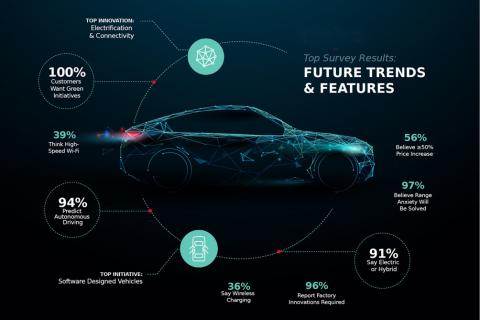
Molex believes it has a good idea of what the cars in 2030 will look like after surveying 230 key people at large automotive companies.
The connectivity and electronics provider has unveiled the results of the global survey of automotive decision makers depicting top trends and technologies impacting car-of-the-future strategies and business decisions.
Survey findings validate the critical role of data, software and networking in enabling electrification and connectivity, identified as the two most important areas of innovation.
“It’s an exciting time in the automotive industry, and this survey underscores the accelerated pace of investment and innovation,” said Mike Bloomgren, senior vice president at Molex. “The results also reinforce our mission to design and deliver critical electronics that form the central nervous system of tomorrow’s connected cars.”
Survey respondents were asked questions designed to help them visualise what an average new car purchased in 2030 might be like, including features, initiatives and innovations.
It found that 91% of respondents believed cars would be either fully electric (64%) or hybrid (27%) with 97% expecting range anxiety to be solved by 2030. And 94% expect cars to include autonomous driving, though only 28% envision fully self-driving cars. Just over half (56%) believe 2030 cars will be at least 50% more expensive than today’s cars.
When asked to identify top areas in the overall ecosystem with the most potential to reduce the price of a 2030 car, battery cost savings (40%), software integration (34%) and manufacturing processes (32%) led the way. In addition, 96% agreed the car of the future would require manufacturing factory innovations.
According to survey respondents, the top three features most likely to be standard by 2030 are high-speed wifi, wireless charging and car-to-car communications. In selecting the five most important innovation areas in the next decade, respondents picked electrification (38%), connectivity (33%), passenger safety (29%), quality and reliability (28%), and software-defined infrastructure (27%).
Moreover, 60% of those polled favour the ability to deliver innovation via software as a priority, encompassing the intelligence needed for autonomous driving, algorithms to reduce energy consumption, remote updates of capabilities and customised driving experiences.
Across the board, participants reported customer demand and technology innovations would impact future car developments, especially in speeding green or socially responsible initiatives, ranging from zero-emission vehicles to zero-waste production.
While 44% of survey respondents envision established car makers driving development of an average car purchased in 2030, 32% cited increasing traction by technology companies. Companies such as Apple, Google and Microsoft are expected to gain momentum because of their expertise in user experience and human-machine interfaces. Equally important is industry sentiment that China is most likely to produce the car of the future first, followed by the USA, Japan and Germany.
Overwhelmingly, participants report major technology challenges to delivering innovation, with 44% citing insufficient battery life and 36% reporting obstacles getting electronics and software to operate in extreme scenarios. Additionally, a third reported challenges in attaining hard-to-find expertise in electrification, 5G, security and other needed technologies.
Molex commissioned Dimensional Research to conduct the survey in November 2020, polling 230 qualified participants in engineering, product, procurement, R&D, supply chain, innovation or strategy roles at automotive companies with at least 1000 employees.
