Renesas dual sync buck controllers suit automotive always-on applications
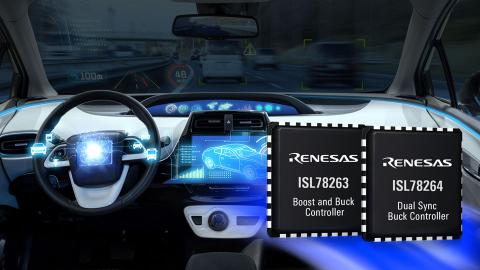
Renesas Electronics has announced a pair of 42V dual synchronous controllers with a 6µA quiescent current and integrated 2A source and 3A sink mosfet drivers that provide primary power stages for the firm’s R-Car H3 and M3 SoCs.
The ISL78264 dual sync buck controller manages the intermediate first stage DC-DC conversion, stepping down the 12V battery system to 5 and 3.3V to power the vehicle’s ECU, in-vehicle infotainment and digital cockpits with 50 to 200W power levels.
The ISL78263 dual sync boost and buck controller provides DC-DC conversion to support power levels of 25 to 100W, while providing a pre-boost if the battery voltage (VBAT) dips to as low as 2.1V during a cranking transient or a start-stop event.
“The ISL78264 and ISL78263 provide the ideal primary stage power regulation for Renesas’ R-Car H3 and R-Car M3 SoCs, which are introducing the automotive industry to new electronic architectures that improve vehicle performance, efficiency, safety and reliability,” said Niall Lyne, vice president at Renesas. “The controllers’ always-on operation and industry’s lowest quiescent current give power system designers the extra margin they need to stay within their 100µA power budget, and can even manage tight budgets down to 50µA. The ISL78264 and ISL78263 integrate strong mosfet drivers that deliver higher efficiency and power compared to other automotive buck or boost VBAT controllers.”
They provide a quiescent current of 6µA typical over a single buck channel. Both controllers simplify power supply design by integrating fet drivers that can deliver 96 per cent peak efficiency and more than 10A output current. They also integrate feedback resistors and an external supply blocking diode for applications requiring cranking support, and programmable spread spectrum for addressing EMI interference.
For example, tolerating a VBAT load dump reduces the additional cost and size of surge protection, while supporting cranking transients lowers the amount of required input capacitance. Having built-in EMI mitigation, with a switching frequency up to 2.2MHz, also reduces the cost and size of EMI filtering and shielding.
They include protection for overvoltage, undervoltage, overcurrent and overtemperature, and a bootstrap supply undervoltage detection and refresh circuit to protect the high-side mosfet.
Both controllers are AEC-Q100 grade-one qualified for ambient operation of -40 to +125˚C.
Features of the ISL78264 include: input voltage operation of 3.75 to 42V; buck-1 Vout is fixed at 3.3 and 5V or adjustable from 0.8 to 5V; buck-2 Vout is adjustable from 0.8 to 32V; Iq of 6µA typical over a single buck channel; 25ns on-times for low duty-cycle operation and 180˚ phase shift between channels; and supports start-stop cranking transients down to 5.5V at 2MHz without requiring pre-boost.
Features of the ISL78263 include: input voltage operation from 2.1 to 42V; fixed buck at 3.3 and 5V adjustable; keeps buck output in regulation through cold-crank transients down to 2.1V; boost frequency at 1x or 0.2x the buck frequency; drop-out mode (buck) for high duty-cycle operation; and 25ns on-times for low duty-cycle operation.
Mass production quantities are available now in 5 by 5mm, 32-lead wettable flank QFN packages.
