Ipetronik updates data logger for vehicle test applications
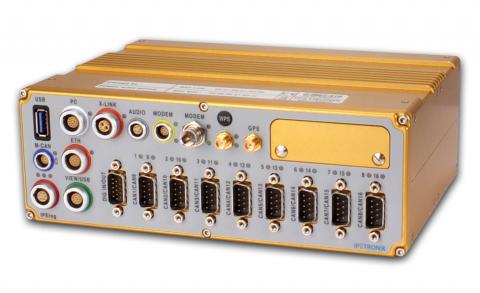
Ipetronik has updated its IPElog data logger for test applications in the automotive and commercial vehicle sector, especially for fleet management.
The IPElog2 data logger is designed around the basic concept and enclosure of the IPElog data logger, but has been improved in various areas such as the audio input, which allows the test driver to record verbal comments and noises event driven – for example via the iMic microphone and trigger button – for subsequent measurement data analysis.
There has been an extension from 14 to 18 bus and measurement inputs as well as the USB 3.0 port for faster configuration updates and data downloads.
Two versions are available. The standard version has ten Can inputs, four of which can be switched between Can HS and Can LS Fault Tolerant. In addition, the logger has six Lin inputs in accordance with Lin 1.3 and 2.0.
The second version has 16 Can inputs, also with HS and LS switchover capability, but no Lin inputs. All Can inputs support the WakeOnCan and NoMessageLost (NML) functions. WakeOnCAN wakes the logger via Can bus activity, such that it automatically boots up from standby and switches to measuring mode. The associated NML function ensures that all the Can messages from waking up the vehicle are saved signal-based as a Can trace.
The data logger is based on a 1.33GHz Atom E3805 dual-core processor, incorporates 2Gbyte ram and uses the Rtos-32 real-time operating system with the Testdrive operating software. Measurement data are recorded using CFast technology with up to 64Gbyte data volume. These storage media have already proven themselves in the M-Log v3 data logger.
To cater to the increasing requirements on Ethernet-based protocols and buses, the data logger supports two Gigabit Ethernet measurement inputs. These inputs allow XCPonEthernet protocols and automotive Ethernet networks to be integrated via BroadR-Reach media gateways. Flexray signals and future Flexray traffic are measured via the Flexray extender.
One of the two Gigabit Ethernet inputs takes the form of an X-Link connector for measuring the high-speed measurement inputs of the X-device family with a sampling rate of up to 100kHz and saving these in the logger. IP-based cameras can also be integrated into the device in future via the Gigabit Ethernet inputs.
As such, the logger also caters to future requirements, such as the synchronous recording of control unit and environmental image data of multiple cameras, say for validating driver assistance systems.
In addition, the logger has an M-Can-Lemo system socket for connecting the company’s M-Can measurement modules. The bus termination can be set via a software switch. Users thus benefit from the fact that no additional M-Can termination connector or special M-Can system cable is necessary for the bus termination. The modules are also supplied with power via this socket.
The logger supports the wireless transfer of measurement data both via an integrated Wifi interface as per IEEE 802.11 a/b/g/n and also via an LTE (4G) modem. The wlan module is capable of setting up an access point itself for connecting terminal devices such as tablets. The modem is modular in design, allowing it to be adapted to the place of installation, including North America, Emea, Apac and South America.
To allow the position data of the vehicle to be acquired synchronously with the measurement data, a GPS receiver plus gyro is built-in. This records the vehicle's rotations along all three axes. Thanks to its functions and properties, the logger is suitable for conducting endurance and fleet tests with the IPE Cloud web portal.
The high-grade aluminium casing measures 206.5 by 73 by 166.5mm in accordance with IP54 protection and weighs 1750g. It has a working temperature from -40 to +85˚C for a relative humidity of 5 to 95 per cent. A voltage of 9 to 36V DC is required for the power supply. Power consumption is typically around 10W. The casing has no fans, hard drives or other mechanical wear parts. The Can, Lin, ETH and four digital IO measurement inputs are galvanically isolated from each other.
"The IPElog2 is a technology carrier which, as regards its architecture and hardware, is designed for catering to customer requirements also over the longer term," said Felix Ottofülling, marketing manager at Ipetronik. “Thanks to the large number of interfaces and measurement inputs, the logger is predestined for extensive measurement tasks with numerous Can and Lin buses. Due to its scalable licensing model, the IPElog2 is available at an affordable entry-level price with four Can interfaces in the basic version. Further functions can be licensed subsequently if required and used immediately."
