Power technologies: Balancing act
Aspiyan Gazder from Linear Technology describes a method for keeping lead-acid batteries balanced
Lead-acid batteries are widely used in a broad range of industries and applications. Golf carts and other industrial electric vehicles are typically powered by a stack of series-connected lead-acid batteries. The telecoms industry uses a series stack of four lead-acid batteries to provide a 48V stack. Energy storage products use lead-acid batteries in various series and parallel configurations to store energy generated by renewable sources such as wind and solar. Series-connected lead-acid batteries find extensive use in the uninterruptible power supply industry to provide backup power when the mains power is lost.
In all these examples, two or more lead-acid batteries are connected in series. When a single lead-acid battery in the stack fails, all the lead-acid batteries in the series stack need to be replaced to maintain battery stack performance. This is a considerable expense.
When batteries are manufactured, they conform to tight specifications for parameters such as energy capacity, effective series resistance, leakage current and number of discharge cycles to ensure quality, guarantee a minimum lifetime and meet various standards. Furthermore, these specifications only apply to a single battery.
There are variations in battery specifications due to limitations in the manufacturing process, and when multiple batteries are stacked in series these specifications no longer apply to the battery stack.
Batteries connected in series will drift over time due to unequal leakage currents, and capacities of individual batteries may change over time. Extreme operating conditions and frequent discharge cycles further exacerbate these problems, which eventually cause one of the batteries in the stack to fail. At that point, the entire battery stack is deemed to be bad, and all the batteries in the stack require replacement.
Replacing a failed battery itself does not solve the problem since the replacement battery’s characteristics would be very different from other batteries in the stack and stack failure would recur. This problem is true for battery stacks made with batteries of any chemistry, not just lead-acid batteries.
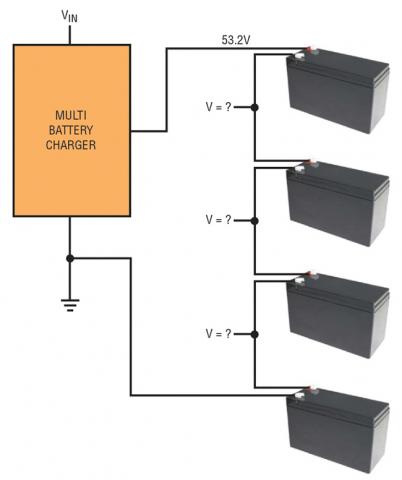
In most series-connected battery stacks, only the voltage at the top of the stack is measured, and it is assumed the batteries in the stack are matched and hence share charge equally. The diagram depicts a scenario in which the top of the stack voltage is programmed to be 53.2V, but the individual battery voltages are unknown and may not all be 13.6V. Since not all batteries in the stack will share charge evenly, some of the batteries in the stack might be severely overcharged while one of the batteries may remain undercharged. Both overcharging and undercharging lead-acid batteries causes battery life degradation.
Overcharging lead-acid batteries causes the electrolyte water to break into oxygen and hydrogen gas, which depletes electrolyte levels in the batteries. This has two effects. The concentration of the sulphuric acid in the electrolyte increases, which is damaging to the battery plates and reduces battery life. Furthermore, since the electrolyte level has dropped, a portion of the plates is now exposed to air, causing plate oxidation and reducing battery capacity.
Sealed lead-acid and gel batteries are particularly sensitive to overcharging since any lost water cannot be replaced. Undercharging lead-acid batteries causes plate sulphation in which the sulphuric acid reacts with the plates to form lead sulphate crystals. This reduces the ability of the battery to accept a full charge, and undercharging worsens. This leads to premature battery failure.
To increase battery stack life, individual batteries in a stack need to be balanced. Conventional wisdom is that overcharging a series stack of lead-acid batteries achieves balancing of the individual batteries in the stack, which in theory helps increase battery life. However, this is a flawed approach.
The only way to ensure that all the batteries in a stack are at the same voltage is by employing a balancing method in which overcharged batteries shed excessive charge while undercharged batteries are given extra charge. An efficient battery balancer requires a switch network that can be used to move charge from one battery to another to achieve a balanced battery stack.
The control circuitry is complex and a discrete implementation is large and costly. However, there are available active lead-acid balancers that enable individual batteries in a series-connected stack to be balanced to each other.
Take an application in which a single balancer is used to balance four series-connected lead-acid batteries. Each battery in the stack is individually and sequentially connected in parallel with an auxiliary cell using a network of ten external low RDS(on) nmos transistors controlled by the balancer.
If the voltages are different, current will flow in the appropriate direction until the voltages of the individual battery and the auxiliary cell are equal. The balancer then commutates to the next battery in the stack. This sequence continues (1, 2, 3, 4, 1, 2, 3, 4) until all batteries in the stack and the auxiliary cell are voltage balanced to within a specified threshold.
The maximum amount of current permitted to flow during any connection is limited by an external positive temperature coefficient thermistor element.
The balancer provides two modes of operation, which are programmable via the mode pin and four termination thresholds, which are programmable via the term1 and term2 pins. The balancer also has overvoltage and undervoltage comparators that monitor the battery voltage and report a fault if the battery voltage is beyond the programmed threshold. The undervoltage and overvoltage thresholds are programmable using the VL and VH pins, respectively, in conjunction with the ISet pin.
Multiple devices can be stacked to balance battery stacks consisting of more than four series-connected lead-acid batteries. Three devices can be used to balance up to ten batteries in a battery stack. Each device needs its own auxiliary cell for the balancing operation.
Balancing lead-acid batteries using the device also has other benefits. Low voltage circuits can be powered from intermediate stack nodes without creating an imbalance in the battery stack. This helps reduce costs since discrete components and IC costs scale with rated voltage. The capacity of the auxiliary cell supplements the stack capacity, resulting in longer run times.
Conclusion
Lead-acid battery packs would benefit from being balanced. A balanced battery pack helps extend stack run time beyond that of the lowest capacity battery in the stack. Furthermore, battery life is also extended, reducing the expense of replacing batteries in the stack due to failure. The complete lead-acid balancing described here allows battery packs to be balanced with a minimum of design effort.
Aspiyan Gazder is a design engineer for power products at Linear Technology
