Sick of self-driving cars? One company has the answer
Steve Rogerson looks at how one company is trying to solve motion sickness in autonomous vehicles
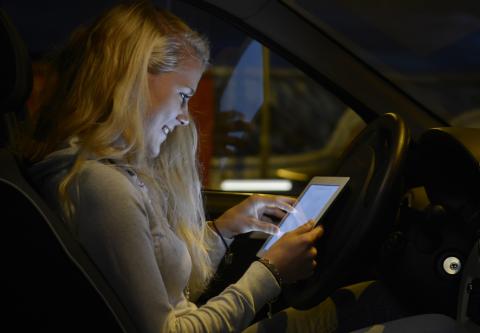
I can read on a train or on a plane, but when I am a passenger in a car after just a few minutes browsing a newspaper I start to feel queasy. This kind of motion sickness is quite normal as suddenly there is a mismatch between what your eyes are looking at and what the motion detectors in your inner ear are telling you.
This poses a serious problem for the proponents of autonomous cars who say that these self-driving vehicles will be allow you on the daily commute to catch up with a bit of work or read a newspaper. I was thus very pleased to hear of the research being done by a UK company called Ansible Motion. Its engineers are deliberately making people sick in a simulator to work out how to stop this unwanted side effect.
The simulator is not just for measuring human reactions, as with other types of automotive driving simulators or those used to train pilots, but can be used to prototype vehicles and different on-car components.
This, says the company, is particularly important for autonomous cars because they involve a complex array of different sensors and on-board systems, which need to play nicely with each other. For example, there’s an entire array of collision sensors and detection algorithms that are mission critical, so it is important to develop these systems with care and consideration, and to give them the computational authority to execute in real time.
When it comes to motion sickness, the simulator enables designers to test different components and conditions entirely virtually, changing things such as the shape of the windows, the vibrations from different road surfaces, sound levels and the car’s suspension. By swapping these components around virtually, designers can see what combination gives the smoothest ride. This means that when the first physical prototypes are created they are already designed to mitigate motion sickness.
“Our own simulation methodology, by default, inserts a layer of controllable sensory content, for motion, vision, haptic feedback and so on,” said Phil Morse, Ansible’s technical liaison.
Normally, there are no modifications made to this layer of the simulation, but he indicates that one way of studying motion sickness is figuring out how to induce it deliberately, by tweaking the simulator’s settings.
“This can be a useful way to explore human sensitivities while people are engaged in different tasks inside a car,” he said. “And then the understanding of these sensitivities can wrap back around and inform the real vehicle design.’
Engineers can induce feelings of sickness by adjusting the simulator’s settings and see the effect on the driver while they are reading or doing other tasks.
All good stuff, but my main question is just how do they find volunteers for the simulation? I can’t see many respondents to an advertisement asking for people to come and be sick. Makes my stomach turn just thinking about it.
