Daf Trucks and NXP demonstrate platooning in Munich ahead of Electronica
Daf Trucks, NXP Semiconductors, Siemens and others are demonstrating platooning live on Munich roads ahead of next week’s Electronica exhibition.
The demonstrations include platooning, traffic signal and vehicle synchronisation, and technology that protects vulnerable road users based on secure V2X.
NXP and Daf Trucks have also announced plans to empower lorry platoons to react 30 times faster than humans in 2017. Achieving this goal would mark a significant milestone in the introduction of platooning to fleet operators who expect efficiency and safety gains while maintaining data security.
Daf Trucks, NXP, TNO and Ricardo previously achieved a breakthrough lorry platooning distance of 0.5s between vehicles. While platooning at 80km/hr, lorries that were linked wirelessly via V2X technology, along with high-performance camera and radar systems, were able to maintain a distance of 11m flawlessly.
The consortium is now cooperating to bring down the minimum distance between lorries by another 40 per cent to 0.3s and 7m at 80km/h. For this, the platooning system will need to react reliably 30 times faster than a human driver. This requires the wireless communications between trucks to take place in the timeframe of milliseconds.
"Helping platoons react 30 times faster than humans is a tall order that we are not taking lightly,” said Ron Borsboom, director of product development at Daf Trucks. “While there is still a lot of research and development required to make this a reality, we are working with NXP on an ambitious plan to demonstrate the improved response time in 2017."
The integration of a sensor fusion and control system can create, monitor and maintain platooning and driving modes in a functionally safe way, even with the occurrence of external hazards or internal malfunctioning system behaviour. Even in the latter situations, the convoy will operate fail-safe.
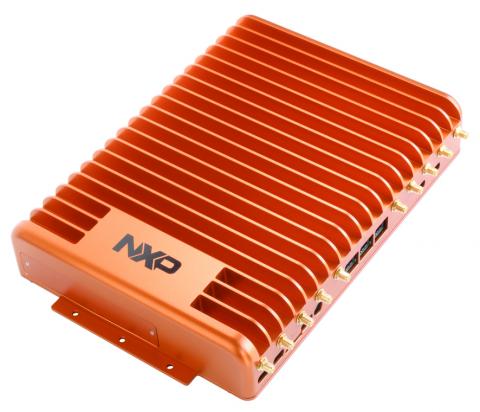
The system will need to operate at a high functional safety level to enable the shorter driving distance safely. This will be accomplished by using Asil qualified components from NXP such as microcontrollers, microprocessors, power management ICs and networking components. The basis for the system development is the NXP BlueBox platform that incorporates most of the components.
“Together with our smart transportation partners we have completed more than one million test days globally in secure vehicle-to-x communications based on NXP’s RoadLink,” said Kurt Sievers, general manager for NXP Automotive. “Our tests have shown the maturity and strong security levels of RoadLink, which is being deployed in its first production cars. The demonstrations with Daf Trucks, Siemens, Honda and other partners underscore the power of ultra-fast, secure and direct communications between traffic participants.”
Enhanced radar will detect road interferences such as cars cutting in faster and more accurately to adjust seamlessly the distance between the lorries. For this, NXP is also announcing a high-performance radar microcontroller at Electronica.
The S32R27 radar MCU is said to offers a leap in performance of four times over the previous MPC577X product. This means higher accuracy and safety for applications such as collision avoidance, lane change assist, autonomous emergency braking, radar cocooning with 360˚ perception or adaptive cruise control. In intelligent transport systems, vulnerable road users such as pedestrians, motorcycles and bicycles can be detected and tracked much faster.
