Infotainment: Only the right noise
Nathan Hanagami, Steve Knoth and Marty Merchant from Linear Technology discuss ways to suppress noise and withstand voltage excursions in automotive infotainment systems
Today’s car dashboards are often crowded with numerous noise sources and temperature sensitive systems such as radios, Bluetooth, GPS and mobile phone-based network connections. Therefore, it is critical that all circuits in this environment, including the power supplies, do not produce excessive heat or EMI.
Further, sudden changes in battery voltage can also significantly disturb a system.
Yet, in spite of these difficulties, the popularity of automotive infotainment systems continues to explode. Modern technological advancements such as satellite radio, touch screens, navigation systems, Bluetooth, HDTV, integrated mobile phones, media players and video game systems have enhanced the driving experience. With more than 50 million cars produced each year worldwide, the majority of new ones have some type of infotainment system integrated.
From a power supply perspective, a basic infotainment console may require several low-voltage power supply rails with several amps of total current, and a premium console may require even more. Traditionally, these voltage rails and current levels have been supplied by a multitude of discrete power regulator ICs or large overly-integrated power management integrated circuits (PMICs).
However, these large PMICs often have more rails or ancillary functions than are needed, require a large circuit footprint and are usually under-powered for some of the rails. As a result, there is a need for a multi-output IC with a small footprint and a configurable number of moderately powered rails.
Power design
Electronic systems design for automotive applications is challenging for many reasons – space is restricted, the operating temperature range must be wide, noise needs to be reduced, battery transients must be tolerated, and quality levels must be high. Since integration levels have to be high to reduce the footprint, this in turn creates a need for power efficient components.
In many cases, there are strict electromagnetic compatibility requirements that cover radiated and conducted emissions, radiated and conducted immunity or susceptibility, and electrostatic discharge. Conforming to all these requirements affects many performance aspects of a potential multi-channel IC design.
Some are straightforward, such as requiring that the DC-DC switching regulators operate at a fixed frequency outside of the AM radio band. However, others are more difficult to address, such as adjusting the slew rate of internal power FETs to reduce radiated emissions due to a DC-DC converter’s switch node transitions.
Feature creep, or the changing of product specifications – such as input and output voltages, and output currents – as the development cycle marches on, can wreak havoc on the selection of ICs and associated discrete components. In a best-case scenario, when a system specification is changed after the board layout is set, perhaps a voltage can be tweaked by swapping a few resistors on an adjustable output converter.
In the worst case, perhaps a number of ICs need to be replaced with non-pinout compatible ICs because the new output current level requirements exceed the switch current rating of the incumbent ones. This will result in a bevy of increased costs and delays due to a redesign and re-layout of the board.
A highly specialised, high performance configurable power management IC is needed to manage the power block properly to ensure that all of the performance benefits of the system can be realised and allow flexibility for inevitable power block system changes. Until now, there has not been a single IC that could accomplish this task.
Simple answers
Historically, many of the existing multi-output PMICs have not possessed the necessary flexibility to handle these modern systems. Any way to satisfy the automotive power management IC design constraints outlined above must combine a high level of integration, including moderate-current buck switching regulators with low voltage capability, wide temperature range of operation, and a high degree of flexibility. What’s needed is a multi-channel, configurable DC-DC converter to address all these issues – one device that can provide high levels of integration and configurability, while simultaneously satisfying the needs of numerous applications.
Buck regulator
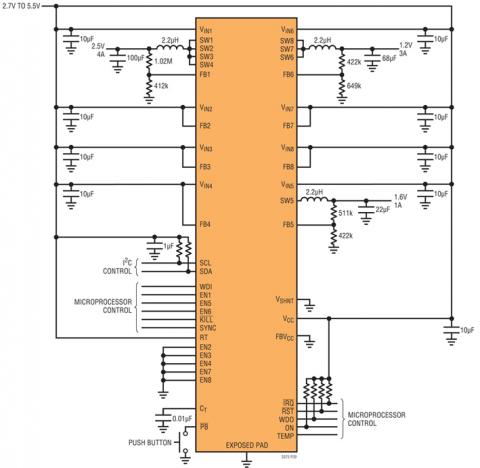
This has now changed. There are highly-integrated general-purpose power management devices such as the one shown in the diagram for systems requiring multiple low voltage power supplies. This device contains eight internally compensated, high efficiency synchronous step-down regulators plus a high voltage always-on linear controller, and is suitable for a wide variety of multichannel applications including industrial, automotive and communications systems.
These eight buck converters can be used independently or connected in parallel to achieve higher output currents with a single shared inductor. Since up to four adjacent regulators can be combined, there can be 15 different possible output configurations.
Suppressing emissions
Devices can include a feature that lets the user slow down the switching edge rates specifically to reduce radiated emissions. There can also be some additional tools for source suppression. The slew rate of the switch on the buck regulators can be adjusted, via I2C. Since the buck regulators are synchronous, both the fall and the rise time are then increased.
Immunity
Another hurdle for automotive electronics is the dramatic changes in battery voltage down to about 5V during cold crank, or from high-voltage spikes. The automotive electronics not only need to survive these harsh voltage changes, but also need to continue operating. The device could have a push-button controller and external pass-FET regulator that can be used to enable an external high voltage buck, which in turn supplies the device with a safe regulated voltage.
Conclusion
Car dashboards are filled with both noise-sensitive and temperature-sensitive sources, making IC design that much more difficult. Drastic changes in battery voltage present yet another challenge. Despite these hurdles, technological advances in automotive infotainment functional blocks, such as satellite radio, touch screens, navigation systems, Bluetooth and HDTV, have enhanced the driving experience in modern-day automobiles.
By replacing numerous discrete power IC components or traditional large overly-integrated PMICs with a single multi-output octal buck IC, a system designer can integrate key power management functions into the system for a new level of performance with smaller and simpler circuits, thus enhancing the modern automotive driving experience.
Nathan Hanagami is a design engineer, Steve Knoth senior product marketing engineer, and Marty Merchant applications engineer at Linear Technology’s power products group
