Design Tools: Competitive advantage
Glenn Reynholds from Mentor Graphics looks at ways to support innovation for electrical system design and harness manufactures
Among the questions in a recent survey of automotive industry executives was: “What are you looking for in new design tools?” The top two on the list are ones that you would expect: Executives want it correct and want it fast. However number three on the list – “Helps innovation” – was surprising.
Innovation now scores above productivity and reducing cost and all the other tool attributes that traditionally were most valued. This shows that executives are very in tune with the importance of innovation to the on-going success of their companies.
But what elements of a design environment promote innovation and how can those elements be surfaced in a way that enables all users to contribute to a company’s success?
Levels of innovation
To frame this discussion, it is first important to understand what the different kinds of innovation are, and what target is within that range.
Breakthrough innovation can have a profound impact on a business, but many times requires a change to the business model or organisation to achieve. There’s only so much of this type of change that a business can absorb.
It’s important to push those envelopes to keep a business viable over the long run, but it is also very important to look at incremental innovation, which is what can happen on a daily basis at every engineer’s desk. To use a baseball analogy: Home runs are cool but singles win games.
The question becomes how incremental innovation can be enabled across an entire organisation and not for just a select few focusing on fundamental change.
Virtual lesson
To enable innovation, engineers must work in a way that puts them in the right frame of mind, where all necessary information is easily available and helps make decisions. To understand what is required to achieve this it is useful to look at how the virtual reality space defines various types of immersion experiences:
- • Narrative immersion occurs when players become invested in a story, and is similar to what is experienced while reading a book or watching a movie. The player is mentally engaged, but in a passive way, just following along.
- • Tactical immersion occurs when performing tactile operations that involve skill. Players feel in the zone while perfecting actions that result in success. This is a more mentally challenging state where decisions have consequences, but the player is still following along with the game and making low-level tactical decisions.
- • Strategic immersion is more cerebral, and is associated with mental challenge. Chess players experience strategic immersion when choosing a correct move among a broad array of possibilities. They must think many moves ahead and mentally weigh the consequences of choices made now against various possibilities from the future.
A design tool should strive to deliver the last of these immersion experiences. Innovation, or at least improved productivity, are advanced by a full mental immersion where engineers can actually run a lot of different types of scenarios through their heads, trying to understand the pros and cons of each, and to answer basic questions about the implications of any given choice and how might it affect other aspects of the design as it matures.
The larger and arguably more important questions include how to get engineers doing their design work into this strategic immersion where they’re able to put together a mental model of where they are headed, and how to preserve that mental model when they are required to stop their train of thought and go to some other location for the information they need to make the next decision and understand its impacts.
A design environment must keep them in that zone of solving the problems.
Strategic immersion
There are a few key areas to focus on to enable strategic immersion in an engineering environment and allow engineers to innovate.
First, to understand fully the implications of design decisions it is necessary to follow a systems engineering approach and design at the platform level wherever possible to ensure decisions are made that optimise the whole platform and are not just localised to a specific part of the design to the detriment of others. Some of the defining characteristics of a systems engineering approach are:
- • Consideration of whole problem;
- • Transition through multiple abstractions, ideally via machine readable executable specifications;
- • Documentation of requirements;
- • Concrete verification procedures; and
- • Emergent characteristics from interactions of sub-elements.
With this in mind as the baseline, further principles can be applied.
Remove distractions
Much of an engineer’s time is spent looking for information. When that information is not readily at their disposal they must break their immersion and go look for it in another place. Once they’ve found the information they must mentally get back to the place they were before to start interpreting the data in context. This constant context switching doesn’t provide an environment where truly innovative thoughts can occur – those brain cycles are spent resetting the context.
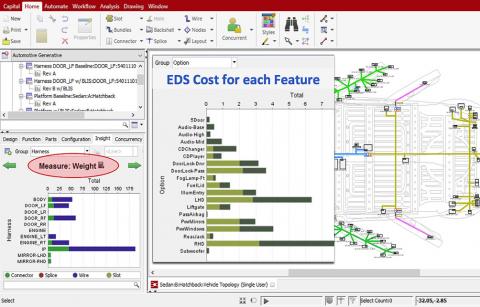
What should be strived for is providing the results of a decision immediately and in a way that is easy to understand in the context of the design. The results might show an effect to other parts of the system that were completely unforeseen, making what seems like a good decision into a bad one on the system as a whole. The key is surfacing a representation of the design data instantly and intuitively, as shown in the diagram.
Eliminate mundane tasks
There are many standard tasks an engineer must accomplish to fulfil an organisation’s process; some of these involve ensuring engineering drawings match the corporate standard so they can be correctly interpreted by downstream consumers of that drawing. Others involve standard checklists of common design errors to be avoided.
These tasks, as well as the act of re-entering data that were provided in one format but must be transcribed to another format before even starting the next engineering phase, waste time and introduce errors by their very nature.
The key to eliminating these tasks and allowing engineers to innovate is applying standards and automation. For example, if there was an electronic definition of an organisation’s drawing standard that removed the need to put text in exactly the right place, with exactly the right font and exact separation from other text, engineers could focus on what the right data are to put into the system instead of spending hours putting them in the right place on the diagram, then making endless tweaks as further data are added.
To enable this level of automation, a design tool must provide a way to capture that model digitally so it can be applied on a daily basis.
Therefore, digitally capturing a process is the fundamental building block to being able to apply automation in a repeatable way. Many times the act of digitally capturing the data exposes holes and weakness in the current process that were previously plugged by engineers using their experience to fill the gap – at the cost of innovation.
This digital capture of process has another big benefit – it doesn’t leave the company when people do. The digital model becomes a core piece of the organisation’s IP that can be updated as new information is learned to improve and optimise the design process continually.
Immediate feedback
The best way to alter behaviour is to provide immediate and direct feedback upon completion of the task. Many of the results of engineering decisions in use today are only available as text-based reports that have to be generated, then interpreted. This is a hold-over from the days of mainframe computers and batch jobs which must be eliminated to enable a strategic immersion experience for engineers. Most engineers are, by nature, very visually based people – they want to see data presented in a way that is easy to understand and compare. The easier it is to understand, the easier it is to make decisions about the quality of the design task they are performing.
In addition to presenting the current state of the data as shown in the diagram it must be possible to compare alternate design choices to understand which is better.
The underlying principle of the design methodology must be based on the systems engineering approach to ensure a globally optimal design is produced.
Summary
By their very nature, engineers want to innovate and will thrive in an environment that fosters it. However, all too often their innovation is crushed by the archaic processes engrained in an organisation formed in a bygone era.
Organisations must undergo change to foster innovation continually throughout all levels and provide a way for every engineer to channel their innovative ideas.
As leaders we can enable this by taking advice from Drew Greenblatt, CEO of Marlin Steel. Greenblatt wrote this in Inc magazine in October 2014: “Among other things, your team needs hardware and software to create the most innovative ideas. It is hard to bend the needle with stale technology at your team's disposal.”
Glenn Reynholds is business development architect at Mentor Graphics