Infotainment: Fast track
Carmelo De Mola from Microchip Technology presents a cost efficient, robust and scalable physical layer for high-speed networked infotainment systems supporting different network topologies
High-bandwidth in-vehicle infotainment (IVI) systems with data rates higher than 100Mbit/s have been historically offered in high-end cars; however, more and more economical and high-volume passenger vehicles are also beginning to offer high-bandwidth IVI capabilities.
Independently from the software-based features that different IVI systems can offer, all share a common base: the need for robust and high-bandwidth underlying physical-layer technology.
Historically, optical Most 150 networks have served the purpose of being the high-bandwidth infotainment physical layer, fulfilling all the demanding OEM requirements with respect to the high bandwidth, scalability, low weight, high robustness, EMC and the capability to fit in to the limited available space in vehicles. However, in spite of the listed features, its cost has represented a barrier for some high-volume car manufacturers.
The need to answer the market demand for a cost-down path for the IVI physical layer, capable of fulfilling the challenging automotive requirements, has triggered an innovation process that has generated a new standardised physical layer for IVI networks based on coaxial cables.
Coaxial cables have many design merits, including:
- • Supporting high-bandwidth data transfer;
- • High shielding effectiveness – robust EMC performance;
- • Available automated connectors assembly process;
- • Satisfying demanding mechanical requirements such as bending capability and high temperature range;
- • Cost effective for automotive grade;
- • Tightly controlled impedance, enabling full-duplex mode of operation; and
- • Making power transmission along with data possible over the same cable.
Furthermore, they have already been used in the automotive industry for decades with a proven track record as point-to-point connection cables. Examples of this include being used for connections between antenna and radio or connections between antenna and a GSM module; therefore, the existing infrastructure for highly-automated production and the corresponding supply chain is well established.
Consequently, automotive requirements regarding temperature range and mechanical requirements are fulfilled as well. Additionally, a standard for automotive connector models (Fakra) is also available and has been adopted by different suppliers. Fakra connectors exist in many different shapes and are provided with different colour and mechanical coding schemes allowing an easy and time-optimised assembling process at the vehicle production line. Fakra connectors fulfil the demanding automotive requirements as well and can be produced using methods with a high grade of automation.
The biggest advantage of a coaxial cable comes from its design. The electric field associated to the signal transmitted through the core conductor is contained within the space limited by the metallic shield. The consequence of this is that the coaxial cable does not radiate energy externally. At the same time, the shieldprotects the core conductor from external electric fields providing high signal immunity.
These two properties of coaxial cables are responsible for the robust electromagnetic compatibility (EMC) performance that facilitates the positioning of a coaxial cable in a vehicle. This also represents a cost saving factor because there is no need to develop special cable routing or observe strict limitations for positioning coaxial cables.
Coaxial cables provide features that are not available in a classic optical Most system. One of these advantages is based on the controlled impedance of coaxial cables that makes it possible to have a dual simplex (DS) communication and a bidirectional full duplex (FD) communication as well. This allows the implementation of additional network topologies in comparison with the classic Most ring and represents an important innovation in IVI networks. For special use cases a combination of DS communications and FD communications could also be implemented.
What follows shows in detail all the networks topologies that can be implemented using a coaxial physical layer.
The classic Most ring on a coaxial physical layer can be implemented based on unidirectional DS communications that require a return cable that closes the ring structure.
Using FD communications instead allows designers to implement topologies that are otherwise not possible. For example, considering a two-node system, a pure point-to-point connection can be realised. In this case, thanks to the bidirectional communications of the FD coaxial line, there is no need to put in place a return cable.
The biggest advantage of this topology is a system cost saving of up to a half is achieved compared with a classic optical two nodes Most ring. This cost saving option is very interesting for high-volume car manufactures because with a two-node system a basic but powerful infotainment system, consisting of a head unit and an amplifier, can be implemented.
For more complex architectures with three or more nodes, the FD communications allow designers to implement a daisy chain topology between the IVI nodes. Also in this case, the absence of a return cable simplifies the car assembly process and contributes overall system cost reduction.
Another network topology that is possible with three or more nodes on a coaxial physical layer using FD communications is the hub configuration. An in-car display unit acting as a hub is connected point-to-point with two rear view cameras that substitutes external mirrors.
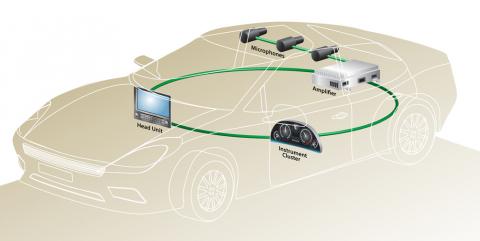
The combination of DS and FD communications allows designers to add new applications to an existing infotainment system based on the ring topology. An example could be to add an audio subdomain with a microphone network to an existing system that was originally developed without supporting a microphone network.
All shown topologies optionally support the transmission of power over the coaxial data line. This allows designers to save dedicated power lines and connectors for each node in the network that is powered over the coaxial cable. This permits cost and weight savings, as well as an easier car assembly process.
The architecture shown in the diagram illustrates the advantages of the transmission of power over the coaxial cable. In fact the camera and microphone modules have a small form factor and therefore the possibility to use a single connector that supports data as well as power transmission simplifies the mechanical design of the modules.
In a comparison of physical layer costs for IVI networks based on a two-node system, the clear result is that a network based on a coaxial physical layer offers the best performance-to-cost ratio.
The advantages of adopting a high-speed networked infotainment system based on coaxial physical layer are obvious. Adoption of this technology by OEMs will begin rolling out this year and the market looks likely to embrace it with open arms.
Carmelo De Mola is product marketing manager for Microchip Technology
