Vehicle Tracking: Anytime, anywhere, anyhow
Steve Knoth, senior product marketing engineer at Power by Linear Products, part of Analog Devices, discusses the power requirements for vehicle tracking systems
A vehicle tracking system can be used for monitoring either a single car or an entire fleet of vehicles. A tracking system consists of automatic tracking hardware plus software for data collection and data transmission, if required.
Active and passive trackers collect data in the same way, and are equally accurate. The main difference between the two types involves time. Active trackers are also called real-time trackers because they transmit data via satellite or a cellular network, instantly indicating where the vehicle is located.
In this way, a computer screen can display this movement in real time. This makes active tracking the best choice for businesses interested in improving the efficiency of their deliveries and monitoring their employees driving in the field. An active tracker also has geo-fence capabilities, providing an alert when the vehicle enters or exits a predetermined location. These kinds of systems can also help prevent theft and help recover stolen vehicles.
Of course, active GPS tracking devices are more expensive than passive ones and require a monthly service fee.
Passive trackers, on the other hand, are less costly but have limited data storage, yet they are smaller and easier to conceal. They store the information on the device instead of transmitting the data to a remote location. The tracker must be removed from the vehicle and plugged into a computer to view any of its information. These systems are good for people tracking their mileage for work purposes or for businesses interested in reducing the misuse of their vehicles.
Also, they are often chosen for monitoring actions of people as well; think of detective work. Passive trackers are a good choice if immediate feedback is not required and there is a plan to check the device’s data regularly.
For either type of tracker, they are portable in nature and have a relatively small form factor. Therefore, battery power is required, as is backup capability to preserve data in case of power loss.
Due to the higher automotive system voltages and currents required to charge the battery – typically a single-cell Li-ion cell – a switchmode charger is desirable for its higher charging efficiency when compared with a linear battery charging IC, as less heat in the form of power dissipation is generated.
In general, embedded automotive applications have input voltages up to 30V, with some even higher. In these GPS tracking location systems, a charger with the typical 12V to single-cell Li-ion battery (3.7V typical) with added protection to much higher input voltages in case of voltage transients from battery excursions, plus some sort of backup capability, would be ideal.
Battery charging ICs
Traditional linear topology battery chargers are often valued for their compact footprints, simplicity and modest cost. However, drawbacks of traditional linear chargers have included limited input and battery voltage ranges, higher relative current consumption, excessive power dissipation (heat generation), limited charge termination algorithms and lower relative efficiency.
On the other hand, switchmode battery chargers are popular choices due to their topology flexibility, multi-chemistry charging and high charging efficiencies that reduce heat to enable fast charge times. They also have wide operating voltage ranges.
Of course, tradeoffs always exist. Nevertheless some downsides of switching chargers include relatively high cost, more complicated inductor-based designs, potential noise generation and larger footprints. Modern lead acid, wireless power, energy harvesting, solar charging, remote sensor and embedded automotive applications are predominantly powered by switchmode chargers for the positive reasons stated above.
Traditionally, a tracker’s backup power management system for batteries consisted of multiple ICs: a high voltage buck regulator and a battery charger, plus all the discrete components; not exactly compact. Hence early tracking systems did not have a very small form factor. A typical application for a tracking system uses an automotive battery and a one-cell Li-ion battery for storage and backup.
Why is it then that more highly integrated power management is needed for tracking systems? Primarily, it is needed to reduce the size of the tracker itself; smaller is better in this market. Furthermore, there are requirements for safely charging the battery and protecting the IC against voltage transients, a need for system backup in case system power goes away or fails, and for powering the relatively lower rail voltages of GPRS chipsets at around 4.45V.
Power backup manager
An integrated power backup manager and charger that solves the problems outlined requires the following attributes:
- • Synchronous buck topology for high efficiency;
- • Wide input voltage range to accommodate a variety of input power sources, plus protection against high-voltage transients;
- • Proper battery charge voltage to support the GPRS chipset;
- • Simple and autonomous operation with onboard charge termination, no microcontroller needed;
- • Power-path control for seamless switchover between input power and backup power during a power fail event; it also needs to provide reverse blocking if a shorted input occurs;
- • Battery backup capability for system load power when the input is not present or fails;
- • Small and low-profile footprints due to space constraints; and
- • Advanced packaging for improved thermal performance and space efficiency.
To address these needs, a complete Li-ion battery backup management system for 3.45 to 4.45V supply rails can be used that must be kept active during a long duration main power failure.
Typical applications include fleet and asset tracking, automotive GPS data loggers and telematics systems, security systems, communications and industrial backup systems.
Thermal regulation protection
To prevent thermal damage to the IC or surrounding components, an internal thermal feedback loop can automatically decrease the programmed charge current if the die temperature rises to, say, +105˚C. Thermal regulation can protect the device from excessive temperature due to high power operation or high ambient thermal conditions and allow the user to push the limits of the power handling capability with a given circuit board design without risk of damaging the device or external components.
The benefit of the thermal regulation loop is that charge current can be set according to actual conditions rather than worst-case conditions with the assurance that the battery charger will automatically reduce the current in worst-case conditions.
Cold-crank ride through
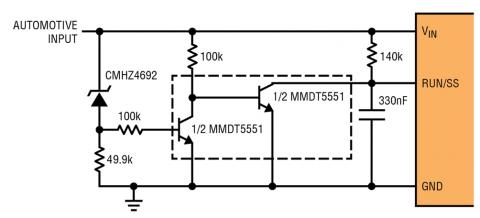
Automotive applications experience large dips in supply voltage, such as during a cold-crank event, which can cause the high voltage switching regulator to lose regulation resulting in excessive VC voltage and consequently excessive output overshoot when Vin recovers. To prevent overshoot when recovering from a cold-crank event it is necessary to reset the device’s soft-start circuit.
The diagram shows an example of a simple circuit that automatically detects a brown-out condition and resets the RUN/SS pin, re-engaging the soft-start feature and preventing damaging output overshoot.
Conclusion
Adoption rates of automotive and fleet vehicle tracking systems are on the rise. Modern tracker form factors have shrunk and features have grown to include active data transmission for real-time tracking. Furthermore, backup capability and lower voltages to power the system GPRS chipset are needed.
A high voltage, high current buck battery charger and power-path backup manager with thermal regulation and other protection can comprise a single-chip for vehicle tracking applications, thus making a designer’s task simpler and easier.
Steve Knoth is senior product marketing engineer at Power by Linear Products, part of Analog Devices
