Volkswagen approves NXP Can transceivers
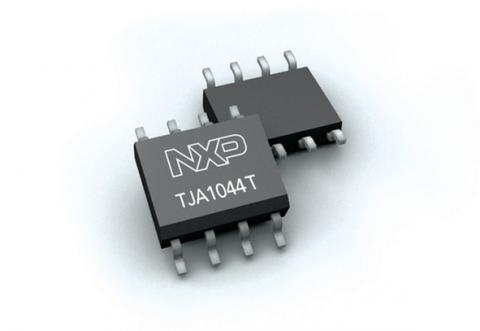
Volkswagen has approved NXP Semiconductors’ Mantis HS-Can transceivers for use in its vehicles without the need for a common-mode choke.
With increasing functions being introduced into the car, the performance of a modern in-vehicle network (IVN) becomes increasingly critical to the vehicle’s safe and reliable operation, with electro-magnetic emission and immunity against electro-magnetic interference being critical parameters to control. Car makers define strict specifications that all transceivers must adhere to before being approved for use in the vehicle. Traditionally, a common-mode choke has been required to reach the performance limits in the application, creating an additional cost of about US$0.1 to 0.15 per module.
Mantis has demonstrated that it meets today’s EMC requirements without requiring a common-mode choke. The transceivers’ performance has reached a level where Volkswagen can successfully remove this additional filtering component and still meet the company’s requirements. This not only reduces costs, but also reduces module space and increases design flexibility.
This announcement marks the first time a German car maker has approved a Can transceiver for use in vehicles without a common-mode choke since the introduction of the stringent EMC requirements in 2012.
“Volkswagen adheres to the strictest EMC requirements in the industry, a critical performance criteria to ensure reliable communication of modules within the car network,” said Carsten Schanze, physical layer expert at Volkswagen. “We, together with the other major German car manufacturers, can only accept devices in our vehicles that fulfil these requirements. In approving NXP’s Mantis transceivers, we undertook an extended testing process. Mantis transceivers are the first devices that delivered the performance for the chokeless use in our car networks and were even used to define the requirements for the location of chokeless networks in the vehicle.”
All members of the Mantis family are dual-sourced from wafer fabs in the Netherlands and Singapore. The family was released in August 2013.
“Volkswagen’s approval of Mantis for use without a common-mode choke in its vehicles is a real landmark,” said Toni Versluijs, vice president and general manager, in-vehicle networking business, NXP Semiconductors. “With this product, NXP has shown that it’s possible to also achieve excellent EMC performance and translate this into real cost savings for our customers and automotive manufacturers.”
Fully ISO-11898-2 and 11898-5 (TJA1044T and TJA1044GT only) compliant transceivers, the devices can take a maximum voltage on Can pins of ±42V. Features include: 6kV ESD handling capability on bus pins (IEC-61004-2 and HBM); compliant with “Hardware Requirements for Lin, Can and Flexray Interfaces in Automotive Application – Audi, BMW, Daimler, Porsche, Volkswagen – Revision 1.3 / 2012”; suitable for chokeless operation at 500kbit/s; logic levels compatible with 3.3 and 5V microcontrollers; standby current (TJA1044T and TJA1044GT) 10µA typical; fully automotive qualified to AEC-Q100; and available in SO8 package.
