Test & Measurement: Made to last
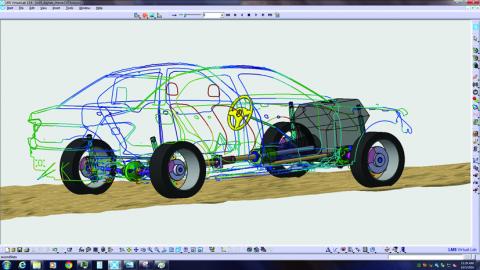
Daimler is standardising on simulation and testing to improve durability
About a decade ago, durability testing was mostly conducted on the test track. Today, with the arrival of digital twins and cutting-edge simulation technology, the old school way of testing is bound to disappear. Or is it?
According to Bruno Seufert of Daimler, not really. Seufert, who is responsible for chassis durability and load data collection and calculation for the vehicles at Daimler, estimates that 65 per cent of vehicle validation still occurs using testing hardware, mostly on test benches and sometimes on test tracks, and 35 per cent is completed digitally. And he sees the trend reaching 50 per cent simulation and 50 per cent testing by 2020.
Seufert should know. He leads a team of 50 engineers who work on chassis durability and vehicle load collection. He and his team know how to design quality vehicles that are built to last and they know they need testing to do this.
Durability
Ask anyone who owns a Mercedes-Benz about their choice and one of the key purchase drivers heard is durable quality. Owners know that a Mercedes-Benz can run for miles and miles and even decades. It is part of the brand DNA and has been for ages. So, understandably, durability plays a very important role at Daimler and a trait the company feels strongly about retaining.
“Our customers don’t want to have something rattling on a car with merely 50,000km on the odometer because of a worn-out ball joint or a bushing that is no longer doing its job,” said Seufert. “Durability plays a big role in these types of quality issues. Not surprisingly, durability can influence the product costs quite a bit.
“Suppose you needed to strengthen a component with a special heat treatment to improve durability. This costs time and money. And this is why we need to make sure that we design right the first time in regards to durability.”
Design right
Daimler’s roadmap for the future of durability focuses on doing as much computer-aided engineering (CAE) as possible without doing parallel tests or measurements. The idea is to do the tests and measurements at the right time on a very high level.
“We made a decision ten to fifteen years ago to standardise our durability process,” said Seufert.
This meant using Siemens product lifecycle management software (LMS).
“We didn’t want to have different technical products on every site,” said Seufert. “We wanted something that would be global. When our test engineers evaluate a time history signal, they do it with the same tool. No matter if they are a test bench engineer, a measurement engineer, a multi-body simulation engineer or a finite element engineer, they are all using LMS Tecware for the time history and frequency phases. They are all using the same tools, like LMS Virtual.Lab Motion for CAE-based durability road loads calculation. They all use the same data formats and process management tools. The LMS helps it all fit together. It really pays off.”
Ten or twenty years ago, Daimler worked vehicle by vehicle when it came to chassis durability. Now the company creates families of vehicles or vehicle platforms. There is a lot more complexity to manage.
“When we are developing a new or updated platform, we sort out the decisive durability factors using calculations,” said Seufert. ”It is really a survival strategy in our competitive market today. We calculate and sort out the best possible component simulations. If they are of a high enough quality maturity, the components will be built and tested.”
Engineering
This methodology is a radical change in durability engineering that has developed in the past ten years and matured over the past three years. In the past, Daimler, as with many other automotive manufacturers, relied on prototype vehicles in the early development phases. Now, the work is mostly done digitally.
“It is a more focused way of working,” said Seufert. “We model all different types of vehicles and then we drive them digitally through our digital test programmes and we analyse the damage content of the loads and forces that we see and then we select the critical ones that need more analysis work. We do the critical work concerning loads much earlier in the development process. Up to two years earlier. With our new development architecture, which integrates LMS Virtual.Lab Motion, we can tell which spot in the structure gets a certain type of load.”
Measurement campaign
That being said, Daimler still does measurement campaigns on-site. Cars are hooked up to 200 or so sensors and driven for hours to evaluate the collected digital data statistically. In a way, it is a crosscheck, but these ideas are taken directly from the LMS customer correlation (CuCo) method. Developed over two decades ago, CuCo originated from a long-term partnership with experts from Germany’s leading automotive manufacturers, including Daimler. For years, durability departments in many of the leading OEMs used this durability methodology and its data for load acquisition.
“We can still get very valuable information from LMS CuCo,” said Seufert. “We still use the CuCo database in combination with our own signal measurements and digital road classification. We mix road types to create different customers in the computer statistically. What we try to find is the most severe customer scenario, that one per cent that represents the driving extreme.”
Digital twins
In the past, Daimler, like many automotive manufacturers, took predecessor data from a test database. In simple terms, the engineers determined that the new car looked similar to an existing vehicle, and used the data from the older model. It usually was close enough, but if there was a new design element, such a different axle, there would be missing data.
“When this happened, we would have to run physical tests,” said Seufert. “With our new digital system, we can digitally create the data that are missing to precisely match the new architecture. This is a great advantage.”
Daimler is working towards having digital twins of all its models and designs. Having these types of accurate simulations provides a clear transition from the digital to the physical world.
“Quite often, it is not possible that the last vehicle we calculated can be measured accurately,” said Seufert. “For example, we get the actual physical prototype perhaps for ten weeks. So the pressure still remains on the measurement campaign. Even though you have a digital twin, it doesn’t necessarily mean that the measurement team is home free.”
Challenges
Even if Daimler is performing its durability work digitally, the prototype still plays a role in the process. When the engineers receive the prototype vehicle, they perform a measurement campaign, combining up to five different measurements at one time. These data are then fed to all the test rigs and suppliers to prepare the final release.
“We still want to reduce the number of prototypes and time is still a huge factor in the testing process,” said Seufert. “That being said, we have eliminated a phase when it comes to collecting loads. Usually, we don’t measure the mule phase any more. The mule phase looks like the old vehicle but has the next-generation technology underneath. We only measure this stage if the degree of innovation is very high. Otherwise, it is CAE simulation only.”
Future
In an ideal world, the designer would sign off on the simulated digital twin, but it is far from this process at the moment. It still requires at least a final test for production release.
“Some properties within chassis durability are really far away from pure simulation,” said Seufert. “Think about rubber and its natural properties. Or all the terrible things everyday people do to cars – scraping the chassis over curbs and speed bumps, splashing through huge muddy potholes. These things aren’t covered in the CAE world yet. Whether it is confirming the accuracy of a simulated component on the test bench or accounting for misuse events on the test track, I can’t see how these critical final testing steps can be eliminated. It is just necessary. Ideally, everything can be cut until those final steps. The final safety test we cannot cut. It gives the unpredictable a chance to occur. We are looking for the unknown.”
The verdict in the end? It seems that the test track and the test bench are here to stay – even if the process of using digital twins is catching up.
