LDRA tries to steer steady course between Autosar and Misra
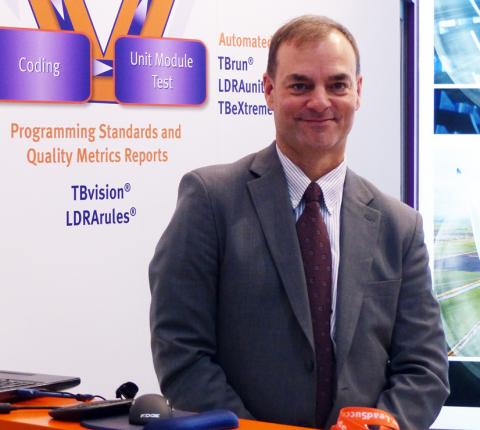
Steve Rogerson talks with Jim McElroy from LDRA
While a row simmers under the surface between Autosar and Misra when it comes to C++ coding standards, LDRA has updated its tool suite in a way that will let users pick and choose between the two.
The problem came to a head last year when Autosar decided to update the 2008 Misra C++ document to bring it into line with current practices, declaring some parts of the Misra publication obsolete and amending other parts.
Misra is meant to be studying the new Autosar document but whether this will lead to an updated Misra version or whether Misra will just let Autosar get on with it, is not yet known.
LDRA decided to bring some inside knowledge on board, hence its recent hiring of Andrew Banks, chair of the Misra C committee, while at the same time adding support for the Autosar C++ 14 coding standard within its tool suite.
“With us, people can pick and choose between the Autosar and Misra standards,” said Jim McElroy, LDRA’s vice president of marketing.
Autosar had to change because the C-based Classic platform was not suitable for the complexities of adas and the road towards more autonomous vehicles. Hence the Adaptive platform, which leverages C++ 14.
“That is why we brought the C++ coding standard into our tool suite,” said McElroy. “But we are fully committed to Misra, which is why Andrew Banks has joined us.”
Banks is a 25-year veteran of safety standards development. After leading multiple coding standards initiatives in the avionics and military space, he spent the last six years focused on ISO 26262 compliance for hybrid and electronic driveline technologies.
LDRA believes this automotive expertise strongly complements the increased adoption of the LDRA tool suite by the automotive industry and enhancements made in the tool suite to streamline automotive safety and security compliance.
The C++ 14 coding guidelines as part of the Autosar Adaptive platform are aimed at high-performance ECUs for infotainment connectivity and adas for automated and autonomous driving. For these applications, the Adaptive platform supports features such as high data-processing capacities, service-oriented communications and over-the-air updates.
The fail-safe operational capabilities of such complex systems will often require multicore microprocessors and robust operating systems potentially using a Posix interface, a requirement that increases software development complexity. The complexity of these ECU applications, often independently developed in distributed work groups, requires automated static analysis tools to ensure standards compliance and software quality consistency across the organisation.
The Autosar standard, which is based on and updates the Misra C++ 2008 rules, also incorporates concepts from other safety-critical standards including Joint Strike Fighter Air Vehicle C++ coding standards, High Integrity C++ version 4.0, Cert C++ and the Google C++ style guide.
With security and safety so interlinked, LDRA is also keen to see the SAE J3061 cyber security standard working alongside the ISO 26262 functional safety standard.
“Both are performing similar activities,” said McElroy, “but 26262 does not do a security analysis whereas J3061 does. We let you bring in the J3061 in the same way you do with 26262 and make it part of the development workflow. The security thing has changed the world so you need more documentation and better ways to deal with it.”
