Connectivity is king
Michael Mauser looks at how new infotainment architectures are delivering connected infotainment into Audi vehicles
Connectivity demands from consumers are on the rise and there is a real need for systems that can seamlessly connect separate domains into integrated products for navigation, entertainment and phone. Audi, with its MMI (or Multi Media Interface) infotainment system, is advancing work in this area, providing innovative solutions to the problems raised.
Today’s drivers expect in-vehicle technology to keep pace with the rate of innovation they encounter with their consumer devices. Connectivity is a crucial element meaning vehicles need intuitive connectivity at source. The new Audi MMI Navigation Plus platform aims to deliver that in a safe and secure way to provide a broad range of connected lifestyle services in the car. Being the “Plus” derivative, the MMI does more; providing navigation as well as multimedia and telephone functions, as well as enabling drivers to view and adjust key vehicle parameters such as climate, suspension and gear shift settings.
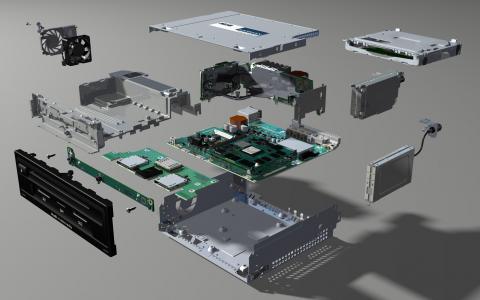
The core of the system is the central MMI unit, and it is this that enables the integration of other devices. With its dual-processor design, it comprises two main units – the car radio control unit and the MMX board (Multi-Media eXtension). This plug-in module integrates memory functions and the latest-generation NVidia Tegra 3 processor to manage online and media apps, voice control, navigation and telephone features. It is also provides the higher graphics performance needed for sophisticated mobile applications. And the unit incorporates a Jacinto processor, which is a specialised processor for automotive infotainment.
A key requirement from car manufacturers is ease of upgradeability, and was a design requisite. From the outset, engineers created an architecture designed to permit hardware to be updated throughout the vehicle lifetime, for example with interchangeable MMX boards.
Long-term connectivity was at the forefront of minds when the interfaces were selected. The latest MMI system is designed to work with the Most 150 interface. Most, or Media Oriented Systems Transport, a high-speed multimedia network technology, has become a de facto standard in vehicles worldwide and is used in a significant number to message between units on the infotainment architecture.
This most recent version, Most 150, provides a physical layer to implement in-vehicle Ethernet. By adding an Ethernet channel with adjustable bandwidth to the control message channel, the system can also stream the data channel and packet data channel already present. Another innovation in the latest MMI system is support for the Can interface. This improves connectivity with vehicle and gateway functions such as car diagnostics and driver assistance features. In the case of Audi, that includes its assisted parking function, for example, all of which creates an integrated control centre in the vehicle.
The infotainment unit is designed to facilitate high-quality playback of music and video files through seamless connectivity with a host of devices. With future broadcasting in mind, it supports Dab, has two SD card slots and can play DVDs. Safety is paramount and engineers decreed that the video image is frozen while the car is moving. Reinforcing connectivity, it also connects directly with USB sticks and MP3 players and the MM display can even show an Apple device’s playlists. As an attractive feature for customers, owners can store music on the infotainment system’s own HDD, creating a form of jukebox.
With demand for high quality audio, the MMI’s engineers wanted to ensure excellent audio feedback. The requirement led engineers to integrate the radio tuner in the main unit, eliminating the weight and complexity of an external unit on Most. A six-channel class D amplifier is also integral, again avoiding the need for a more complex, distributed architecture. Selecting a class D amplifier offered the advantage of a theoretical power conversion efficiency of 100%, with no heat dissipation. It also helped the engineers keep weight and package size down, a key requisite for today’s vehicles.
Internet connectivity
Arguably the most important device to connect is the user’s phone. Smartphone integration is fast becoming a key element within the infotainment system; with data, music and phone contacts, users need simple ways to dock devices into the vehicle system. Research indicated that Sim Access Profile, supported by many phones, and enabling the phone to connect to the car and use its antenna, was the preferred option. For users not wishing to connect a phone, the MMI can be fitted with a sim card.
Audi online services allow the car to retrieve up-to-date information from the internet via mobile networks such as LTE. The LTE network supports downstreaming data rates of up to 150Mbit/s. This could enable high speed streaming of movie data. As well as LTE, the MMI works with GPRS and Edge (UMTS) modems and on-board wlan. This provides occupants with a stable hotspot and reduces driver distraction.
Demand from the market led to the introduction of a Map (Message Access Profile) client, which enables the infotainment unit to download and display emails from vehicle occupants’ portable devices and smartphones.
Unlike other premium car manufacturers, Audi has elected not to use a touchscreen preferring a control dial as its central interface. This is rotated to navigate up and down through menus, and pressed to activate functions. To avoid drivers taking their eyes off the road, it can also be voice-controlled The latest version of MMI Touch has a separate touchpad for entering addresses or selecting songs.
Navigation plays a key role in the MMI. The integrated GPS is complemented by 3D city maps, 3D landmarks, digital terrain modelling, and 3D brunnels (bridge and tunnels), plus web access to weather and traffic information.
With the latest-generation MMI with Navigation Plus, drivers can now also connect to Google Streetview. Data are buffered when the connection is active, meaning that data loading operations are undetectable to vehicle occupants. To avoid roaming charges that users might incur accessing the web or apps outside their country, the integrated GPS navigation function itself works without a connection with the internet.
Michael Mauser is executive vice president and co-president of the infotainment and lifestyle divisions at Harman
