Clever cars
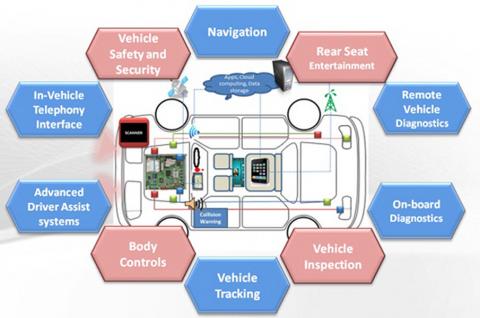
Vageesh Kumar explores the world of intelligent in-vehicle infotainment
Automotive infotainment is one of the fastest growing technologies in the industry – a growth trend expected to continue with the smartphones technology boom.
Consumers want PC-like responsiveness, human-machine interface and power from every device on the go. Meeting this growing demand for the best possible consumer experience, within time-to-market demands, is increasingly falling in the infotainment domain.
Infotainment units are hardware devices used in vehicles to provide navigation, connectivity and audio and visual entertainment. Most vehicles nowadays have infotainment for entertainment, connected with devices such as personal navigation systems and smartphones with a hands-free car kit. Smart phone connectivity bridges the product life cycle gap between car infotainment systems and smartphones, using the advances made in a rapidly expanding smartphone based infotainment system.
In-vehicle infotainment features include handset integration, head-up display, infotainment systems for driver assistance, interior personalisation and cloud-based infotainment. The million dollar question is: Can a smartphone replace all systems used in the car, from dashboards and navigation systems to car audios and telematics?
Integrating technology to support multiple features or systems is not a new idea. Indeed, many automotive component suppliers are involved in integrating the existing car navigation system with the car audio and the mobile phone, using a hands-free kit or Bluetooth.
Fresh thinking and focus is all that is required to bring about a change in the automotive infotainment domain. Including a cluster dashboard in the integrated product with a smartphone could well be the future trend. The possibility of standardisations, with Mirrorlink, which uses virtual network computing (VNC), has added strength to handset integration.
Infotainment systems are not only used in entertainment, they are also used in road assistance for driver safety, with features such as video and data recording from rear view and night vision cameras and black box recording. Add an augmented reality head-up display and you not only have a driver that stays focussed on the screen, but also one that assimilates more information on the fly.
There is a huge and growing market opportunity for in-vehicle infotainment (IVI) systems that create a superior in-car user experience. The interlacing of the car’s IVI system with the driver’s mobile device and applications can help achieve that connected car experience. The main mobile applications used for music streaming include Spotify and ITunes, with each media player using different methods to get user experience data.
This convergence enables the creation of innovative applications that interact with the electronics control unit for remote monitoring and control in-car multimedia experiences, navigation and internet connectivity.
Intelligence in IVI can be used in various scenarios and with different implementation approaches.
Proposed approach
With rapid growth in smartphone and cloud technologies, consumers are clamouring for live streaming of music, internet radio and smartphones. Ideas for advanced infotainment features integrate both user behaviour and the next level of data based infotainment systems. They can:
• Add power to IVI by manually personalising the media source playlist or by automating the choice of entertainment based on user behaviour data. User behaviour data is derived by analytics inputs from interactive voice recognition, based on the mood of the vehicle owner.
• Enrol on-demand entertainment from cloud-based sources to intelligent in-vehicle infotainment instead of local media databases such as DVD players, or Bluetooth streaming audios.
• Share and store media files such as photos, music and videos. Examples include cloud based media databases such as Twonky, Plex and air video. This sharing of media files will lead to saving local space and having more media choices between groups.
Universal plug-and-play and digital living network alliance software helps people enjoy personal and online music, photos and videos. It is also used to share favourite media with PCs, TVs, stereos and other devices connected to the network.
Vehicle-to-vehicle communications can be used to transfer music by extending vehicle interior personalisation such as ambient and mood lighting, and instrument cluster rearrangement to include the user’s choice of music. This opens up the possibility of completely altering how the car’s dashboard and other interior components look.
Having integrated technology by extending the human-machine interface of smartphones with navigation units, virtual network computing, hands-free or Bluetooth interfaces can also be used.
Registering vehicle health reports on an infotainment device would also be possible as an advanced feature. This is a feasible scenario as intelligent in-vehicle infotainment acts like a standalone electronics control unit (ECU) and could easily be interfaced by a gateway to talk to other ECUs. An application that is resident on the infotainment unit can typically use standard on board diagnostic tests to provide vital health information.
Typical use cases
This system architecture could, for example, be used for intelligent profiling. It could detect kids in a vehicle through an interactive voice recognition system or an image processing system, using the human detection algorithm.
Then, if you have broken your promise of taking them for a picnic, playing songs of their choice could perhaps appease them!
Also, lone drivers, identified by interactive voice recognition or image processing, could choose pre-set music or make a mood-based profile to help them relax.
Profiling can be achieved two ways – manually or semi-automatically. Semi-automatic profiling takes various inputs such as voice recognition for identifying persons, a human detection algorithm to detect images of users in the cab, or even noise level detection.
More intelligence can be added by getting cloud-based songs, depending on the user situation. Indeed, making an interactive radio by requesting for a song to be broadcast is one of the challenges that need support from the cloud or a frequency modulation radio service provider.
Behaviour analytics
Some existing media players distinguish user behaviour patterns in thick and thin clients, where analytics is done on the device itself, as well as on the cloud. Media players use their own technique or approach to analyse user behaviour. The big disadvantage is that logging too much user behaviour data makes the device performance low. A cloud-based system, which distinguishes user behaviour patterns using analytics, is done online. Cloud based players perform better, as they put a lower burden on the central processing unit.
Examples include: Genius Mixes in ITunes; the Last FM feature in Spotify; the history based choice feature in Pandora; and the history based channel selection satellite radio.
For example, ITunes has a big music database with intelligence in PC applications. It uses the Genius feature to create a playlist from the library based on a single selected song played on the drive. Spotify, however, streams music online, has an on demand option and is mostly free. And Pandora chooses a song or artist based on history.
Conclusion
Allowing users to personalise their cars and infotainment systems with user experience data, music, apps, themes and colours of their choice can only enhance their driving experience. Integrating these features with customised human-machine interfaces to retain brand identity can be a key to success in an exponentially growing industry.
Vageesh Kumar is an executive at Mindtree, specialising in the automotive domain
