Lighting: Bright future
Joachim Reill, senior director for applications engineering at Osram Opto Semiconductors, studies the use of lighting in the car of the future
Every year, vehicle manufacturers release a car representing the most sophisticated technology available for commercial use. The vehicle in question deploys state-of-the-art materials and features using the latest technologies to ensure the safety and comfort of both the driver and its passengers. Beyond better engine efficiency and the reduction of emissions, the car of the future is also upgrading the driving experience itself.
The use of visible and invisible light is helping to advance the efficiency of driver assistance systems, automotive driving to information transmission, infotainment and even interior lighting to change the driving experience.
Progress
Vehicle technology is progressing across a wide range of fields. Engine efficiency and emission reductions are two areas that continue to see advancements but one area experiencing significant innovation is enhancements to the driving experience for both driver and passengers alike.
Indeed, the possibility of completely autonomous vehicles are no longer the work of science fiction. A lot of this progress can be attributed to the use of visible and invisible light, which forms the basis for the implementation of many systems supporting these improvements. When it comes to optoelectronic technologies in today’s cars and concept vehicles, a lot of the attention has been heaped on light detection and ranging (lidar) laser technology.
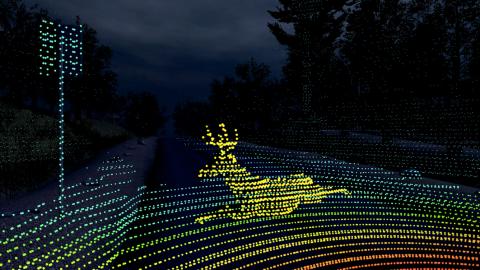
Lidar systems use a pulsed laser beam that is scanned across the field of view in small, angular increments. A fast sensor, or sensor array, then detects the reflected beam and produces a long range, high-resolution 3D image of the environment around the car. However, it is developments in IREDs (infra-red emitting diodes) that are making headway in bringing a multitude of advancements closer to market.
Light is helping to advance the efficiency of driver assistance systems, automotive driving to information transmission, infotainment – or even interior lighting to support alertness or encourage relaxation at the appropriate time. With effective application of light, the car of the future could be used in a public transport capacity.
Biometrics
Biometrics technology is largely considered to offer a high degree of security and is extremely user-friendly, but its success relies on the application of highly effective optoelectronics, designed specifically for security applications.
Unique human characteristics, including facial features, palm prints, handwritten signatures and hand geometry, are identified, and then compared with previously stored biometrical data of authorised users. The optimum lighting of the characteristics with IREDs in specific wavelengths is key to an error-free identification.
Human centric lighting will be used in cars to change the lighting to match a passengers’ biorhythm, syncing with wearables such as fitness trackers, smart watches or mobile phones. Ambient lighting adds a feel-good element, or even alerts to provide the driver with key information that can help the car of the future feel more like an extension of the user’s lifestyle, adapting to their preferences at all times.
There has been a huge leap in developments in biometric technology based on IREDs, spurred on by new possibilities to make vehicles safer and more convenient to access. Perfecting the sensors required for such technology is crucial for the safety of all vehicle users.
User safety and security will continue to be a key feature in all vehicles to come. Iris scan and facial recognition technology will be deployed for secure access to a vehicle and passenger profiling, which will then automatically adjust the car to the passenger’s specifications. Additionally, concerns over vehicle cleanliness can also be addressed via UV light-based technology, spotting bacteria and stemming the risk of germs.
Marketing
Interior lighting also provides a significant opportunity for marketing, particularly in public transport. Projection systems based on LED technology could be used in several different applications, such as visuals projected onto the car’s glass panes.
As vehicles continue to develop, the use of visible and invisible light will be crucial to the success of the industry. Using light in the most effective manner, the car of the future will be able to accommodate the needs of passengers and drivers to a higher standard, while also ensuring absolute safety for both users and pedestrians.
External projection could be used to alert pedestrians to key information, such as parked cars alerting passers-by to keep clear of a loading area. In case of a technical issue, coloured lights could be used to inform a driver of a certain situation or relay information. Sensor systems based in cameras can also leverage infra-red light to detect whether the driver is fatigued or distracted, thus activating a warning to the driver to take a break if required.
With autonomous vehicles, passengers will be able to focus on other things instead of driving; LEDs will allow visuals to be projected onto the car’s glass panes. By doing this, branding, advertisement and in-house entertainment can be projected for passengers alike.
Conclusion
Ultimately, the true car of the future can’t be predicted to 100 per cent accuracy. However, based on the emerging technologies available and currently being tested, a steadily clearer image of what to expect is emerging. The car of the future will be able to accommodate the needs of passengers and drivers to a luxurious standard, while also ensuring absolute safety for people within vehicles and pedestrians around them.
Joachim Reill is senior director for application engineering at Osram Opto Semiconductors
