Covid-19 wreaks havoc on automotive power semiconductor market, says Omdia
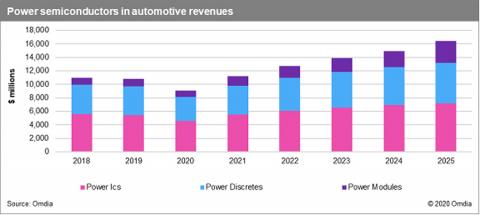
Covid-19 is wreaking havoc on automotive power semiconductor revenue in 2020 with the market set for a 16 per cent drop as vehicle sales dive and production plunges, according to a report from Omdia.
Worldwide revenue for power semiconductors used in automotive applications will fall to $9.1bn in 2020, down from $10.8bn in 2019, according to the report.
“The year 2020 had been expected to bring a rebound for the automotive power semiconductor market,” said Kevin Anderson, practice lead for power, automotive and industrial semiconductors for Omdia. “However, the Covid-19 pandemic shut down most automotive assembly plants for several weeks, first in China and then throughout the rest of the world. At the same time, demand for new vehicles has fallen as dealerships were closed and lost jobs and wage reductions in many parts of the world combined to slash demand.”
Even those plants that have reopened are not all operating at full capacity, due to component shortages and reductions in the numbers of employees on production lines as physical distancing measures are implemented. As a result, current new-vehicle build forecasts envision production of less than 70 million units in 2020, a decline of more than 20 per cent from 2019.
Power semiconductor devices, including discretes, modules and ICs, are used extensively throughout automotive electronics. This widespread adoption has propelled strong annual growth in the high-single-digit percentages for the automotive power semiconductor market in recent years.
However, 2019 brought a reversal in that trend. Trade tensions throughout the year combined with on-and-off tariff negotiations and the decline in some regional economies reduced vehicle builds and caused the market to decline by one per cent compared with 2018.
After experiencing declines in the low single digits in 2019, discrete power semiconductors and power ICs for automotive applications are expected to post sharp revenue losses of 17 per cent during the current year. These devices are used throughout vehicle electronic systems and, because the electronic content and the complexity of those systems are increasing, the impact of reduced vehicle production on their revenue has been limited.
Power module revenues grew seven per cent in 2019, benefitting from the increased manufacturing volumes of electric vehicles (EVs) and hybrid EVs (HEVs). Similarly, only an eight per cent decline in power module revenue is forecast for 2020.
The revenue outlook for various automotive domains is also mixed.
Revenue from the fast-growing adas module market posted a 12 per cent increase in 2019 and is expected to fall by only three per cent in 2020. In powertrain systems, revenue grew one per cent in 2019 and is forecast to decline by 13 per cent in 2020.
Sales of higher-value power modules are expected to rise due to the automotive market’s conversion to HEV and EV production. The other domains – body and convenience, chassis and safety, and infotainment – grew in the mid-single digits in 2019 and are expected to decline by a high-teens to low-20s percentage in 2020.
As the major world economies seek to reopen after lockdown, a gradual pickup in sales is expected in the second half of 2020. If a serious second wave of the virus can be avoided and a Covid-19 vaccine or improved treatments can be developed by early 2021, then a rebound of vehicle sales is envisioned for 2021.
This would result in an increase in power semiconductor sales close to the mid-20-per cent range in 2021. Furthermore, the long-term compound annual growth rate (CAGR) would return to seven per cent for the years 2019 to 2025.
Omdia is a technology company established following the merger of the research division of Informa Tech (Ovum, Heavy Reading and Tractica) and the acquired IHS Markit technology research portfolio.
