Denso opts for AMD Xilinx in lidar platform
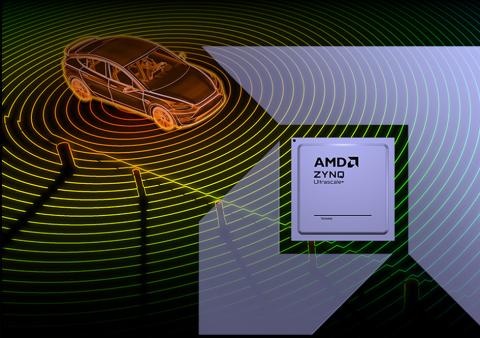
AMD’s adaptive computing technology is powering mobility supplier Denso’s latest lidar platform.
The platform will enable an over twenty times improvement in resolution with low latency for increased precision in detecting pedestrians, vehicles, free space and more.
Targeted to begin shipping in 2025, the lidar platform will leverage the AMD Xilinx Automotive (XA) Zynq UltraScale+ adaptive SoC and its functional safety suite of developer tools to enable ISO 26262 Asil-B certification.
Denso is using the AMD XA Zynq UltraScale+ multi-processor system-on-a-chip (MPSoC) platform in its single-photon avalanche diode (spad) lidar, which is said to generate the highest point-cloud density level of any lidar on the market.
Point-cloud density describes the number of points within a given area and is analogous to image resolution, where richer data ensure that crucial decision-making details are captured. Generally, spad-based systems are being adopted by automakers because of the space savings that can be achieved.
The adaptable XA Zynq UltraScale+ MPSoC lets Denso reduce the size of current lidar implementations, allowing multiple lidars to work in tandem for forward view and side views of a vehicle. One device can be used for multiple lidars, including future implementation, which drives down costs and helps designs be future-ready.
Vehicles in production may have just one forward-looking lidar, but future vehicles will have multiple systems including forward-, rear facing- and side-view lidars. The additional systems are needed to move beyond driver assistance to full autonomy.
Denso lidar can also be used for infrastructure monitoring, factory automation and other non-automated driving applications.
“We are excited to expand our collaboration with AMD as we introduce our next-generation lidar,” said Eiichi Kurokawa, head of sensing at Denso. “AMD high-performance, highly scalable, programmable silicon offers distinct benefits for the extremely complex image processing requirements of our lidar sensor architecture. The flexibility and capabilities of the Zynq UltraScale+ MPSoC platform and its ability to meet stringent functional safety requirements led us to work with AMD.”
The spad lidar can generate over three million points-per-second at ten frames per-second. This middle-range lidar uses XA Zynq UltraScale+ MPSoCs for system monitor functionality to help enable the temperature and overall system to function correctly. Because the system uses time-to-digital conversion instead of analogue-to-digital converters, the overall system size and cost can be optimised while still delivering high-performance high-density data.
“Denso has developed an exceptionally precise lidar,” said Mark Wadlington, senior vice president at AMD. “With lidar continuing to evolve, there are new technology requirements, driving the need for improvements in sensitivity, density and performance. Through AMD adaptive computing technology, we’re helping to enable a reduction in size and space, while also improving resolution for increased precision in object detection, all at very low latency.”
