Market focus: driver assistance
Luca De Ambroggi and Akhilesh Kona believe the semiconductor market for driver assistance is on fast track
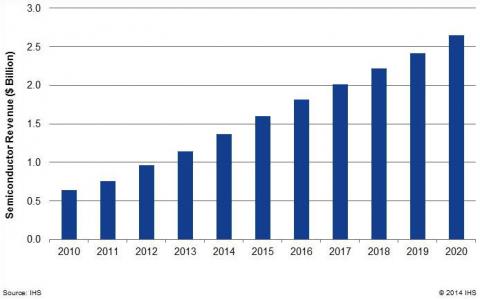
Among automotive technologies, semiconductors used for advanced driver assistance systems (adas) have shown a significant progress during the past couple of years. Semiconductor revenue for adas grew 18% in 2013 from US$1bn in 2012. Revenues are estimated to double in 2016 to $2bn.
Our research indicates that adas semiconductor growth will be steady for the next 15 years, due to an increasing amount of functionalities and features that will be integrated in the car with the aim to deploy fully autonomous vehicles. The trend passes also through the implementation of data fusion modules because of the need of more sensing redundancy and higher functional safety requirements as found in ISO 26262 and Asil compliant standards.
Top runners
Today, semiconductor revenue for front-view camera applications is growing particularly fast. Its cost position, the demand from customers and the encouragement from regional mandates and safety regulations are major drivers. Revenue for semiconductors used in front-view camera modules is expected to grow by six times in 2020 from $118m in 2013 with 27.6% CAGR.
One of the possible mandates from the European Commission is to have LDW-AEB (lane departure warning and automatic emergency braking) as mandatory in every car from 2016. This has caused a boost to semiconductor revenues for implementing LDW-AEB with a front-view camera module. Semiconductor revenue for implementing AEB with a camera for pedestrian detection according to Euro NCap’s definition is expected to grow twenty fold in three years from 2013.
Also, the revenue for semiconductors used in radar and lidar modules is estimated to grow threefold in 2020 from $236m in 2013 with a CAGR of 16%.
Radar technology
Gallium arsenide (GaAs) based radar chipset suppliers indicate that they are tending to phase out since the GaAs radar chipsets cost more than the silicon germanium (SiGe) variety. Deployment of adaptive cruise control and blind spot detection systems is set to rise because of affordable SiGe radar chipsets.
The 24GHz radar sensors are likely to phase out by 2020 giving way to the 79GHz radar technology because of a possible mandate on dedicated frequency bandwidth for automotive applications. Among others, Panasonic, ST Microelectronics and Freescale Semiconductors are developing the 79GHz automotive radar using 5GHz (77 to 81GHz) of bandwidth.
Lidar modules are expected to play a major role in implementing active control applications in more sophisticated autonomous driving systems, which many OEMs are targeting in the 2020 to 2025 time frame, depending on the flavours in vehicle autonomy.
However, an accurate detection of surroundings around a car might not be enough when implementing autonomous driving systems. Additional systems should be present inside the car to monitor the situation of a driver and also the passengers along with the driver. For this reason, applications such as driver monitoring and road frustration index make autonomous driving a more reliable and safe technology, relying even more on prevention.
Dynamic market
An important point is that the transition of driver assistance systems from passive (warning only) to active (active control) is happening fast. Semiconductor revenue for active systems is expected to increase fourfold in 2020 from $190m in 2013. Semiconductor revenue for passive systems is expected to reach $1.8bn in 2020 from $953m in 2013 with a CAGR of 9%.
Nonetheless, we are still a bit far from autonomous vehicles. The term “autonomous” is very attractive but quite generic and it spans across different levels where drivers have different roles and responsibilities in the car.
Examples for vehicle autonomy go from self-parking and platooning functionality, through self-driving under limited road and traffic condition with drivers still maintaining control, up to fully autonomous vehicles. Fully autonomous vehicles are however not expected to hit the market soon, not before 2030 to 2035. It will happen though.
Independent of technologies and electronics, the next 20 years will see the requirement to prepare an entire ecosystem for autonomous vehicles. Mandates and regulations need to be shared among different countries. Legal implications and liability for autonomous vehicles need to be closely considered and regulated.
Furthermore, OEMs need to build from scratch a database of possible situations and test patterns to play with. System and vehicle testing needs to be bullet proof before the launch of autonomous vehicles. This extended testing, and the effort in design for testability, will probably increase the share of production costs, in addition to the increasing amount of electronics and software.
Acceptance and trends
Today’s acceptance and diffusion of several adas technologies are already reflected in the market trend for multi-function adas modules that tend to optimise hardware and adas functionalities. Multi-function systems have been progressively rising for a couple of years. Regional NCap bodies have driven car makers to offer more adas functions such as LDW-FCW (lane departure warning and forward collision warning), LDW-HBC (lane departure warning and high beam control) or LDW-TSR (lane departure warning and traffic sign recognition) to achieve a five-star rating.
Since 2012, the minimum number of applications implemented by OEM front-view camera modules is at least two. The number of car makers that have implemented a single adas application with a front-view camera module is negligible. Different types of multi-function systems implemented with a front-view camera module are:
- • Stand-alone: Single application implemented by a front camera module such as LDW, LKA (lane keep assistance) or HBC;
- • Basic multi-function: A combination of two functions implemented by a front camera module such as LDW-FCW, LDW-HBC or LDW-TSR;
- • Mid-range multi-function: A combination of three or four functions implemented by a front camera module; and
- • High-end multi-function: A combination of five or more functions implemented by a front camera module.
At the end, the multi-function system approach reflects nothing else than the ever green trend that accompanies electronics and semiconductors since their origins: integration and consequent cost reduction.
On the semiconductor side, the integration affects micro-component ICs (controllers and processors) and sensors in the path to optimise efforts and space to implement adas successfully. Among the micro-component IC suppliers, Infineon Semiconductors, Freescale Semiconductors, Renesas, Texas Instruments and ST Microelectronics have high-end processors on their roadmap which are capable of implementing multi-functions. In particular, both micro-component ICs and sensors occupy major space in semiconductor revenues for adas. Such optimisation and integration trends have an obvious impact on the overall bill of material.
Architectural approaches
Keeping in mind the above factors, many technology makers have been trying to achieve a cost-effective and viable approach using different methods.
Integrated methods include high functional integration in single hardware, high relevance of software for system scalability leading to high flexibility, and flexible system architecture and high computational power. A modular approach provides hardware scalability, adjustments based on feature attach-rate, easy decoupling between safety-critical and non-safety-critical hardware, and easier implementation of redundancy schemes.
Luca De Ambroggi and Akhilesh Kona are analysts in IHS Technology’s automotive semiconductor department
