Connected cars: Next step
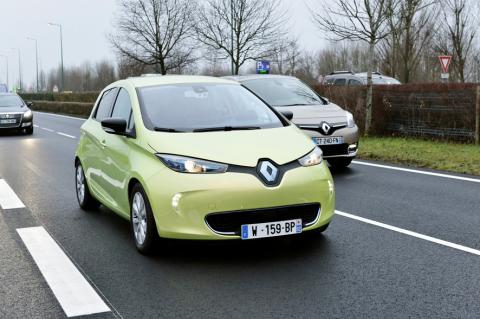
Renault has produced a prototype to show how it believes connected cars will look by 2020
Increasing the connectivity in modern vehicles is accepted as a vital step if the goal of autonomous driving is ever to be fully achieved. To illustrate this vision, earlier this year Renault unveiled the Next Two, a prototype for what it believes the connected car will eventually look like, and a vision that is not that too far away as the car maker has already earmarked 2020 as the model year for a production version of the vehicle.
“Thanks to the Next Two autonomous prototype, Renault’s aim is to take up position right now in this field of advanced technology which we believe will reach the marketplace by around 2020,” said Carlos Ghosn, CEO of Renault. “With Next Two, we wanted to combine the worlds of delegated driving and connectivity. Not only will autonomous driving enhance safety but it will also free up time for drivers. Being connected will enable them to make the most of this extra time by providing them with access to new in-car services such as video-conferences, on-line shopping, travel information and more.”
And this is a key element of this prototype in that the connectivity is not just being used for vehicle-to-vehicle and vehicle-to-infrastructure communications, but also for giving the driver something to do while the car is driving itself. At the moment, Renault is only predicting the use of autonomous driving by 2020 in cars travelling at up to 30km/hr in congested traffic. It does, however, see an extension of automatic parking to valet parking where the car will not only park itself but will also find the car parking space.
Meanwhile, the passengers and driver can ensure their free time is well spent by tapping into what Renault calls “a hyper-connected mobile lifestyle”. The idea is for it to pick up all available networks from 3G and 4G to Wifi and what else might be around by 2020 and run all mobile operating systems, such as Apple and Android.
“Everybody is looking to save time, particularly when it comes to driving,” said Frédéric Mathis, who is in charge of the Next Two project. “Next Two has consequently been designed to help occupants optimise the way they manage their time and ensure that wasted or lost time becomes useful or enjoyable by freeing up opportunities to relax, educate oneself, have fun or work.”
According to Tom Tom and Inrix, a daily return commute of just one hour loses drivers between 60 and 80 hours a year in major European and American cities. On top of that, drivers are subjected to stress and increased tiredness, which can have a long-term effect on their health. And, according to market watcher Gartner, these journeys account for a total annual fuel consumption in Europe and the USA of 16bn litres.
The hope is that connected cars can address all these problems, freeing up the driver’s time to relax or concentrate on other issues while the driving pattern of traffic flow through a connected city should reduce fuel consumption significantly.
Meeting time
As an example of how this will work, Renault has invented Juliette, a sales representative who receives a text message telling her she has an off-site meeting and that to get there on time she will need to leave the office at 4pm. Her smartphone tells her to expect a 43 minute journey that includes 20 minutes on a congested trunk road that allows delegated driving.
Using the valet parking app on her smartphone, she tells the car to pick her up at 4pm outside the building, which it does autonomously. If she wants, she can use the smartphone to look at the views from the various cameras on the car.
As she approaches the car at 4pm, it recognises her, unlocks the door and adjusts the seat and mirror to her preferred settings. It evens tunes the radio to her favourite station. The navigation screen and head-up display show her route.
As the car reaches the delegated driving zone, Juliette lets the car take over and the seat automatically adjusts to comfort-mode settings. Juliette uses the free time to prepare for the meeting and accesses information stored in the cloud. She also initiates a video call to a colleague to get some last minute information.
But the car suddenly warns her of an unexpected delay ahead that will make her late for the meeting. She can call her customer to say she will be late, but the car comes up with an alternative that she chooses. So, it leaves the main road, heads for a nearby car park and downloads a metro ticket to her smartphone to allow her to complete the journey by underground train. The car drops her off at the station and finishes parking on its own.
Affordable technology
The Next Two prototype is based on the Renault Zoe and is equipped with a camera, forward-facing sensor and ultrasonic field around the vehicle to form a protective bubble. The company has strived to make the technology being demonstrated affordable for average motorists.
“Next Two is a realistic prototype which incorporates technologies that are sufficiently well-developed to be built into production models in the medium-term future,” said Mathis. “It takes advantage of affordable technologies with the aim of making their use as widespread as possible.”
The front-facing sensor is used to analyse the vehicle ahead, calculating how far away it is and at what speed it is moving. The camera serves to detect lateral markings on the ground, to position the vehicle correctly in its traffic lane. On this, Renault is working in collaboration with the Vehicle-Infrastructure-Driver Interactions Laboratory (Livic), a research laboratory born out of Inrets and which specialises in advanced driving assistance systems.
“It helps us to define driving strategies in accordance with the varying reliability of the information received from the ground markings," said Mathis.
The data received from the sensor and camera are forwarded to a supervisor which, in turn, communicates with the control units for the electric power steering, motor and decoupled brake pedal. To keep up with the flow of traffic, it adapts the instructions it transmits to the motor and brakes. Similarly, to keep the vehicle in the same lane, it sends the steering system an instruction of what angle to follow.
The calculator must ensure that there are no contradictions between the various instructions sent to the steering, motor and brakes, to avoid the car accelerating midway through a corner, for example, or braking suddenly due to an ill-timed detection.
“We have also paid particular attention to the way the driver resumes control of the vehicle,” said Mathis. “This embedded intelligence makes all the difference between Next Two’s delegated driving functions and the separate adas functions such as automotive cruise control and lane keeping assist, which already exist today.”
For the vehicles to switch to delegated driving mode, Renault believes the connected cars must be on a protected route that does not allow pedestrians or cyclists. Notably, some other car makers disagree with this believing that an autonomous car will be far better able to deal with pedestrians and cyclists that a human as its reaction times will be quicker. The car maker also sees such routes as limited to a maximum 30km/hr, again contested as others believe that faster moving motorways pose far easier problems for autonomous vehicle designers. For practical purposes, the delegated driving period should be a t least five minutes, say Renault, to make it worthwhile for the driver to start some other task.
Renault though realises that some of this vision is limited and is looking at this area but wants to take it one step at a time.
“Our ongoing research work seeks to ensure the most seamless transition possible between periods of delegated driving and times when it is the driver in control,” said Rémi Bastien, Renault’s director of engineering and innovation. “We are working to extend the delegation of driving functions in progressive stages, regardless of the level of complexity, to include fast roads and motoring in built-up areas. Obviously, increasing the scope of the zones where driving can be delegated also increases the diversity of situations that are covered, placing ever-greater importance upon the validation of our findings.”
Renault’s first consideration concerned the automatic mode. When the car takes over, the head-up display (HUD) becomes blue. The aim of this is to create a reflex in the driver’s mind that associates the colour blue with the automatic mode.
“To prevent ambiguous situations, we wanted a basic binary, on-off system which immediately indicates how the car is being driven at any given moment,” said Mathis.
When driving of the vehicle is being delegated, the HUD and dashboard display allow a perfectly logical dialogue to take place between the driver and the car. An augmented reality system involves superimposing additional information that is useful to the driver onto a real image, a form of augmented reality. The car maker also decided to take advantage of this while the vehicle is being driven conventionally to deliver a type of enriched navigation. Anyone who has already used a navigation system knows that in certain complex situations – such as roundabouts or at motorway junctions – it is not always easy to find your marks and take the correct decisions.
"In the case of Next Two, the arrow is superimposed onto a real-time image of the road ahead which is projected onto the HUD,” said Mathis. “This makes navigation simpler whatever the circumstances because the arrow is portrayed in the vehicle’s actual position on the road. Even if the road ahead is concealed by a truck, the driver knows exactly where to head or to turn. The system also highlights those traffic signs that influence the vehicle’s speed, such as warnings of a pedestrian crossing or a dangerous bend, for example. The others are not highlighted, however, so as not to overload the driver’s attention.”
When driving is being delegated, the driver can take his or her eyes off the road. In this case, the HUD serves to display information that reassures the driver with regard to what the vehicle is doing. For example, if the car is calculating its position on the road in relation to a target vehicle ahead, this vehicle is highlighted. At the same time, the detectability of the road’s ground markings is displayed during the delegated driving mode so that, should the car estimate it is insufficient and ask the driver to take over, the latter knows instantly why by looking at the display.
Conclusion
Many car makers are pinpointing 2020 as the model year when the big changes in adas and connected vehicle technologies will hit the road. Renault’s vision with the Next Two gives some idea of what we can expect.
