Making the connections
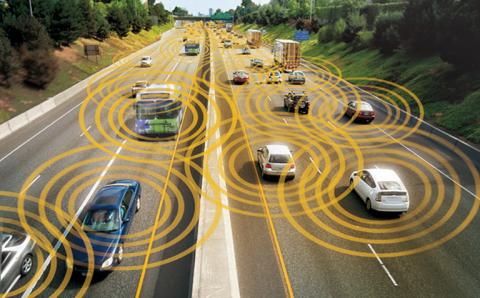
Car2x communications are changing what it means to drive, explains Lars Reger
Over the past twenty years, the biggest innovations in the automotive industry have come from the field of electronics. Landmark developments include anti-lock braking systems (ABS) and electronic stability control (ESC). It is again in electronics where we are going to see the next big step forward in automotive development.
Our digital era is ushering in a new evolution in car technology; the connected car. While the concept of the connected car is already well understood by the industry, what exactly will form the core elements of a connected car is still a matter of debate. But it is very likely that one of those core components will be car2x communications – intelligent systems integrated into vehicles capable of collecting and analysing data from other vehicles (car2car) and supporting infrastructure (car2infrastructure).
Urban driving
The number of people living in cities is expected to double by 2050, meaning congestion and road accidents will continue to be a global problem. Networked cars are being touted as the answer to many of these issues, making driving safer, more efficient and eco-friendly. A key technology for networked cars will be the Wifi based car2x-communications, which are described by the IEEE802.11p standard. This technology enables cars to build ad-hoc networks with other vehicles and infrastructure in their environment.
The basic idea behind car2x is that if a number of vehicles transmit information from various sensors about location, speed and other data such as ambient temperature, a dynamic model can be created that represents the local environment.
In other words, using data collected from surrounding cars the vehicle is able to gain vital information about the current road traffic situation. It knows in advance that the traffic on the motorway is backing up less than a kilometre ahead or even that the traffic light ahead will change in a few seconds. These messages can be sent to the driver instantly or, if necessary, the vehicle can respond automatically. Applications of this kind can improve road safety, especially in critical traffic situations at high speed or in bad weather conditions.
The data collected from vehicles can also help public sector organisations gain more intelligence about conditions at road level. For example, if anonymised data collected from hundreds of cars in a particular area show that the ambient temperature has dropped and that windshield wipers have been engaged, the authorities can prepare for snowy conditions. Road defects can also be more easily spotted by analysing driver behaviour. If cars are braking and swerving in a particular location or suspension data registers severe vibrations in the road, repair crews can be sent directly to that location.
Beyond that the potential increase in road-safety offered by networked cars is enormous. According to a study conducted by the US Department of Transportation, car2x safety functions such as collision-mitigation at intersections and emergency braking assistants could reduce accident rates by up to 80%. Given that an estimated 1.2 million people are killed worldwide every year on the roads and fifty million injured, the technology could save thousands of lives. Other benefits include reduced congestion, which will help to create greener more efficient cities.
While car2x undoubtedly has a lot of benefits, linking vehicles to the internet of things also raises a number of concerns. Turning a car into a mobile IP address makes the vehicle susceptible to problems encountered elsewhere in the consumer world, a major one being security.
With the advent of the connected car there will inevitably be more data generated about where and how we drive. But while no-one would like anyone inappropriately gaining access to information about our driving habits, it is the risk of manipulating the car itself and surrounding infrastructure that presents the biggest dangers. So to ensure hackers are unable to gain control of vehicle functions, special security standards must be met.
Data security
Car2x works by creating ad-hoc data exchange networks between the vehicle and environment – in other words, independent, self-organising networks of mobile users. The range of such systems is up to 1.5km and transmission protocols derived from the common wlan are used, such as wlan standard IEEE 802.11p. As with any other wireless lan, communications are exposed to security risks that have to be guarded against.
First, the quality and integrity of data have to be ensured. Intelligent vehicles must be able to detect whether data have been altered and falsified for any reason when collected or transmitted. Wrong or defective data can block the applications on which they are based or render them ineffective – in the worst case becoming a genuine safety risk.
For instance, if false data mislead a vehicle into incorrectly recognising the speed of the vehicle driving ahead, there could be fatal consequences. So mechanisms need to be integrated that can detect bad data, remove them from the communications circuit or destroy them entirely.
A basic requirement of an intelligent connected vehicle is that transmitted data should be encrypted and secured. The purpose of encryption is to ensure that exchanged data cannot be manipulated and to determine that data really originate from a specific, trustworthy vehicle.
Exchanged data should be accompanied by a certificate that can be decrypted at the receiver end with a public key. The security of keys and certificates would take maximum priority in the system and can be assured at the highest possible level by the embedded secure elements. This process is enabled at chip level, incorporating special microcontrollers that unite automotive and security and safety functions into one system.
Another important point to consider is that of compatibility or the upgrade capability of the communications system that has been fitted into a connected car. In this area there are marked differences between automotive and consumer markets. Cars tend to have much longer development and lifetime cycles than digital consumer goods. Most smartphones are only on the market for a couple of years before the producer stops supporting them with updates. So you want to ensure the safety-relevant functionality of a networked automobile is supported and updated for its lifetime – and that might be a whole decade or more.
The answer to this will be to implement software that is as independent of the hardware as possible, such as Java-based systems, which guarantees sustainability of the algorithms that are used and which protects them, as much as possible, against misuse.
Market
So when can we expect car2x to be implemented throughout the automotive industry? Field trials such as Spits (Netherlands), Sim TD (Germany) and Safety Pilot (USA) have already shown that car2x is ready for the road. The results of Sim TD field trials were published in June 2013, involving 120 test vehicles driven a total of 1,650,000km in 41,000 hours. In view of this success, more concrete plans are being called for to implement the technology.
At the start of February 2014, the US Department of Transportation announced plans to promote adoption of car2x. And the US National Highway Traffic Safety Administration is already working on a draft proposal that prescribes car2x technology in future vehicle generations. The department expects this measure to speed market penetration of car2x in the USA.
The automobile producers represented in the Car 2 Car Communication Consortium are already looking at worldwide harmonisation of network standards for wireless communications of data and information between vehicles, traffic infrastructure and service providers, with implementation as early as 2015 or 2016.
Lars Reger is vice president for strategy, new business and R&D for the automotive business unit at NXP
