Ferrari switches simulation software mid-season
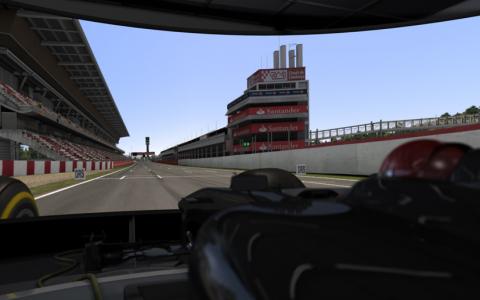
The Ferrari Formula One team has taken the decision to switch to new simulator software mid-season, risking simulator downtime. It is now using driving simulation software from specialist software company RFPro that models the world’s grand prix circuits with claimed unprecedented levels of realism and response speed.
The change was implemented following convincing results during evaluation by Ferrari engineers.
Ferrari’s decision to change operational software mid-season underlines the scale of the performance improvement potentially available because simulator downtime in F1 can mean costly interruption to the engineering development schedule. Ferrari already had well-developed DiL (driver-in-the-loop) software in which it had invested significantly over a number of years, but the leap in performance was too great to ignore.
“The trial of RFPro was so promising that we immediately put it to use in production-intent applications within our F1 team,” said Ferrari’s Giacomo Tortora, responsible for vehicle dynamics.
To be fully effective as an engineering development tool for supplementing the limited track testing permitted in F1, simulation software must reproduce the track surface in minute detail and respond to dynamic inputs faster than the driver can detect. Terrain Server from RFPro is the first simulation package to satisfy both these requirements fully, and was selected after an exhaustive evaluation process.
"I think Ferrari’s tests are the most demanding faced by any vendor,” said Tortora. “We tested video bandwidth and latency, road surface data quality and visual accuracy for the digital circuit models. It is important that the circuit model captures the road surface accurately, but also that it can be validated to ensure that our vehicle model is running on the same road surface as the real car.”
To ensure the necessary level of track surface detail, the system uses lidar scanned data, reproducing surface features in 3D with an accuracy better than 1mm in z (height) and 1cm in x and y (position), representing a ten-fold improvement over the resolution previously available. In addition to its existing library of circuit data, RFPro can provide customers with turnkey systems for scanning, modelling and providing high definition lidar data for other tracks, or even public road test routes.
"The way in which Terrain Server captures every lidar scanned data-point within the tyre contact patch, and integrates them all to provide our vehicle model with accurate road input, improves correlation with our measured data and also feels more realistic for the driver,” said Tortora.
Ferrari was equally demanding of the response speed, or latency, of the system, according to Tortora.
"Video bandwidth is very important to us because we run multi-channel stereo projection and also wanted the fastest possible refresh rate,” he said. “RFPro is able to deliver the maximum video bandwidth, in stereo, at very high refresh rates with just a single frame of latency between our vehicle model and the projectors. This is the fastest on the market: video bandwidth is probably an order of magnitude greater than traditional Open GL based systems."
With most of the top F1 teams now using RFPro’s software, the company is turning its attention to the mainstream automotive industry, where the potential applications are even greater. The ability to simulate a vehicle’s dynamic behaviour accurately, with a driver in the loop, makes it feasible to assess extreme situations such as those encountered when testing adas, ESP and other control systems designed to affect the dynamic behaviour of the vehicle.
