Microcontroller tackles always-on sensor applications
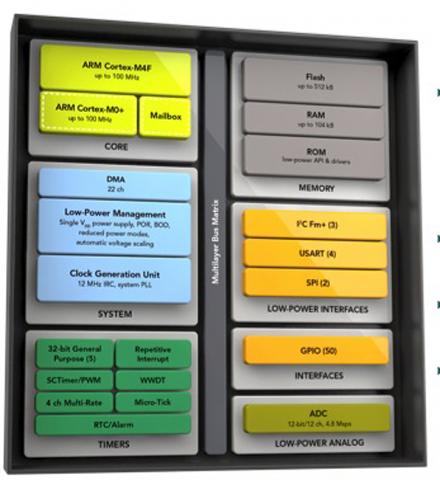
Targeting the fleet monitoring and asset tracking markets, the LPC54100 microcontroller from NXP is aimed at always-on sensor processing as it requires just 3µA for continuous sensor listening.
“In automotive, there are more and more sensors being added and many of these always need to be listening,” said Ross Bannatyne, general manager at NXP. “Consuming power is important for battery life. There is so much electronics, the automotive manufacturers are trying to reduce power consumption so you don’t have a flat battery if you leave your car in an airport car park for two weeks.”
The chip has two Arm cores – the 55µA/MHz Cortex-M0+ core for sensor data collection, aggregation and external communications, and the Cortex-M4F core (100µA/MHz) to execute maths-intensive algorithms, such as motion sensor fusion, more quickly while saving power.
“There are some applications within automotive for which this product will be a perfect fit,” said Bannatyne. “Fleet management systems will use it for tracking vehicles and the behaviour of a vehicle. The microcontroller will be connected to the sensors that monitor the position of the vehicle.”
This architecture is complemented by a range of analogue and digital interfaces designed from the ground up for power efficiency, including a 12bit, 4.8MS/s ADC capable of full-specification performance at the full voltage range – 1.62 to 3.6V – as well as low-power serial interfaces.
NXP has partnered with Bosch Sensortec to offer an application-in-a-box sensor processing and motion system that combines an LPC54102 microcontroller, nine popular sensors, including Bosch Sensortec’s motion and pressure sensors and sensor fusion middleware, and NXP’s LPCXpresso development platform and support. This should make it easier for users to incorporate motion and other sensor-based features.
“This is for any kind of motion sensor application,” said Bannatyne. “Say your vehicle was using GPS to monitor the position and you went into a tunnel or a built-up area and lose the GPS signal, this type of software will be used on the motion sensors to calculate the position of the vehicle so the navigation system could continue to show the road the vehicle was travelling on.”
The microcontroller is sampling now and expected to be in full production in January in WLCSP49 3.2 by 3.2mm and LQFP64 10 by 10mm packages.
