Wearable sensor detects driver drowsiness
A wearable sensor that promotes safer driving has been introduced by Fujitsu and is due to go on sale in Japan next month. The Feelythm detects when drivers are drowsy based on their pulse.
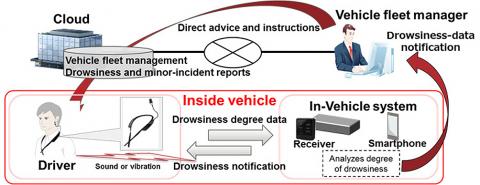
The product, which uses a proprietary algorithm developed by Fujitsu Laboratories, monitors the driver's pulse via a sensor attached to the earlobe, gauges drowsiness based on that, and notifies the driver and their vehicle fleet manager. It can also connect to digital tachographs and other onboard devices, and link to fleet-management systems so fleet managers can monitor the conditions of their drivers in real time and provide helpful guidance based on objective data.
In the near future, it will be possible to improve safe-driving management by predicting dangers before they occur based on an accumulation of sensor data indicating fatigue, stress and tension, and applying that to a hazard map.
Human error not attributable to driving violations or skill has accounted for approximately 67 per cent of all traffic accidents in recent years. Legal reforms and support for devices that promote safe driving from Japan’s Ministry of Land, Infrastructure & Transport are aimed at improving this situation.
Given this background, Fujitsu developed Feelythm for fleet vehicle operations such as buses, trucks and taxis, to be usable in various businesses and environments.
In the interest of comfort, the main part of the device is worn around the neck and weighs about 90g. A sensor is attached to the earlobe to measure vital signs such as pulse rate and the autonomic nervous system. The algorithm determines the driver's level of drowsiness with a high degree of accuracy, and the device gives sound and vibration alerts to the driver. The device was designed with long-haul driving in mind, with battery capacity for five continuous days operation.
Automatic calibration and a learning function adapt to the ranges of readings in vital signs that will vary from person to person and detect drowsiness more accurately.
Connecting these devices to a fleet-management system lets managers monitor detection data and gives them objective data to help strengthen their safety management.
Moving forward, Fujitsu will put to use hazard maps that compile and distil driver data and stress conditions to bring hazard prediction to fleet operations and expand support for driving-safety management.
The company is aiming to sell 70,000 units over the next three years.
