Leveraging electronics to reduce in-cabin road noise
Rajus Augustine, director of business development at Harman, looks at ways to lower in-cabin road noise in next generation cars
As audio quality all around us continues to improve, expectations are surging regarding what good sound should be – be it the surround sound at home or headphones for portable devices. And when it comes to the in-car listening experience, this expectation is higher than ever. A recent survey highlighted that over 70 per cent of 18 to 24 year olds now prefer listening to music in the car over anywhere else.
However, the car cabin remains a challenging acoustic environment to reproduce good quality sound. Audio designers may know the precise listening locations of the occupants, helping them to create location-based audio sweet spots, but unwanted in-cabin noise intrusions coming from the road and interfering with the audio listening experience have been hard to tackle. Some 55 per cent of respondents in a recent survey cited the droning sound caused by road noise transmitted through the vehicle structure as the number one complaint in an environment where they want to enjoy their music.
Current trends in vehicle design and manufacturing significantly impact the noise levels in vehicle cabins. Multi-link suspensions create multiple noise paths into the vehicle. An increasing desire for better vehicle handling and cornering has led to engineers specifying stiffer bushings, which in turn tend to allow more unwanted noise into the cabin. Add to that the universal trend towards wider low-profile tyres, these measures while being aesthetically appealing and providing for an exhilarating drive experience, more often than not exacerbate the low-frequency noise induced by road vibrations inside the car cabin.
Moreover, in their pursuit to meet regulations around fuel economy and CO2 emissions, OEMs worldwide place a lot of emphasis on weight reduction. For example, the latest Peugeot 208 is 100kg lighter than the previous model, and the new BMW M4 tips the scales at 80kg less than its predecessor. To pare down the weight, car makers often use light-weight structural materials, which in turn negate the chassis capability to damp-out noises coming from the road surfaces, causing in-cabin noise intrusions. Traditional NVH (noise, vibration and harshness) methods typically involve adding heavy damping material to tackle the low-frequency noise. The added weight increases fuel consumption and emissions and can impact vehicle handling and overall performance.
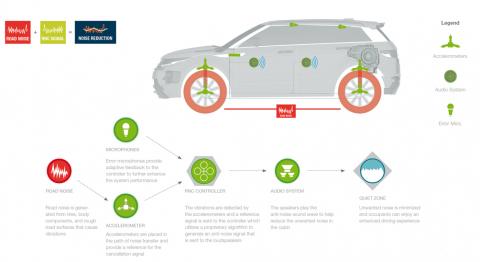
An electronic method that uses most of the existing audio system architecture now provides OEMs with a practical way to cancel road noise without the associated weight penalty potentially associated with traditional NVH measures. Road noise cancellation (RNC) technology works by generating anti-noise to counteract the low frequency drone caused by vibrations transmitted from the road surface into the vehicle cabin.
To implement RNC, accelerometers are placed along the suspension and chassis of the vehicle to provide a reference signal to the system controller. The controller in turn uses an algorithm to create inverse sound waves that are output through the car’s standard audio system, cancelling out the noise caused by the road-induced vibrations. Additionally, error microphones in the roof of the car provide adaptive feedback on the cabin noise level to fine-tune the cancellation, helping occupants enjoy an enhanced driving experience. Moreover, the system ensures that only unwanted road noise is cancelled, while preserving music signals.
With consumers’ increasing expectations on better in-cabin audio listening experience, coupled with OEMs seeking measures to reduce weight, CO2 emissions and fuel consumption, electronic noise reduction technologies looks destined to become one of the key enablers to enhance the in-cabin listening experience.
