Microchip launches Most 150 transceiver for coaxial cables
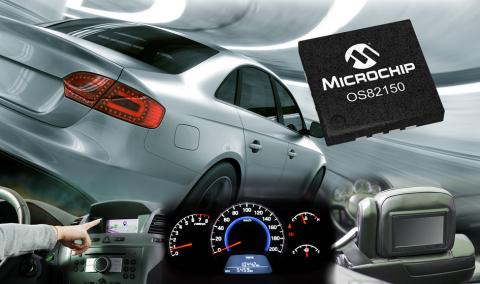
Microchip has introduced a Most 150 coaxial transceiver to enable robust and cost-efficient automotive infotainment networks based on coaxial cables. The OS82150 integrates a coaxial cable driver and coaxial cable receiver into a 4 by 4mm QFN package.
It should enable easy migration from optical to coaxial cabling while protecting the user’s existing investment in Most 150 technology.
This is said to reflect market demands for powerful automotive infotainment systems that include a navigation unit, antenna module, amplifier, tuner, Bluray player, rear-seat entertainment, instrument cluster, head-unit display, camera and more. The Most networking technology provides the means to distribute these multimedia entertainment functions among the various control devices inside the car.
With an integrated coaxial-cable receiver featuring an equalising function, the transceiver assures robust and reliable network connectivity by providing automatic adaptation to various cable types and continuous compensation for initial and long-term cable-loss effects.
Designed for automotive-grade electromagnetic compatibility the device also integrates functions to reduce electromagnetic emissions and handle automotive electromagnetic interference levels, facilitating smooth installations of Most 150 networks into vehicles.
By seamlessly interfacing with Most 150 intelligent network interface controllers, such as Microchip’s OS81110 and OS81118BF, the OS82150 can be integrated into existing designs. Additionally, the signal and timing specifications are compliant with the Most physical layer specification, ensuring interoperability.
Additional features include a low-power sleep mode with activity detection for wake-on-signal functionality to reduce power consumption and facilitate the power management of electronic control units in the vehicle. Support for dual-simplex transmission allows for a ring topology that enables expandability and scalability of the network. A single, 3.3V power supply eases design-in, as only a single voltage level is needed.
To enable development and speed time to market, the device is supported by K2L’s OS81110 cPhy evaluation board and K2L’s Optolyzer Mocca bundles. The evaluation board encapsulates an entire Most 150 network device.
An integrated OS85650 IO companion chip provides IO port expansion for additional application flexibility. The Mocca bundle combines the capabilities of the Optolyzer Suite graphical user interface with the advantages of the Optolyzer Mocca multi-bus hardware interface.
