Infotainment: Listen on
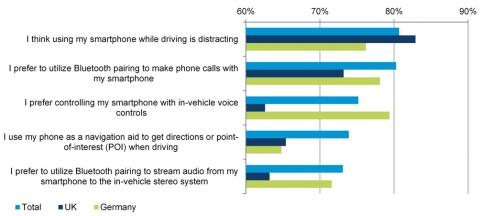
A recent IHS survey investigated the use of smartphones and listening choices in vehicles
As the rate of smartphone use in vehicles continues to grow rapidly in nearly every major market globally, vehicle manufacturers and suppliers are rushing to integrate and incorporate design and connectivity elements into new vehicles to address the market demand and desire among consumers.
More than 85 per cent of new car intenders in Germany and the UK have a smartphone, according to recent research from IHS Automotive.
The report, Apps in the Car 2015, includes regional preferences from a recent consumer study conducted by IHS Automotive. More than 4000 vehicle owners who intend on purchasing a new vehicle within the next 36 months were surveyed, representing four key automotive markets – the USA, China, Germany and the UK.
“Across the UK and Germany, we saw very similar results, though not exact,” said Colin Bird, senior analyst, automotive software, apps and services at IHS Automotive. “Consumers in these countries rely on their phones for in-vehicle connectivity and use a variety of apps while driving. Our research identifies many trends that can help foster further development for technology in vehicles sold in these countries.”
Among new vehicle intenders in Germany, Samsung smartphones led the way with 49 per cent of respondents indicating Samsung as the brand they owned and used most often. Apple ranked second at just 21 per cent. In the UK, ownership of Samsung and Apple devices was nearly equal with Samsung edging out Apple by just a percentage point margin (34 per cent Samsung to 33 per cent for Apple). Respondents from the UK also showed the largest variety of smartphone brand ownership in the survey, demonstrating an opportunity for vehicle app integration ecosystems that cater to a wider variety of devices, according to the research.
Operating systems also varied, with 67 per cent of German consumers reporting Android use compared with just 21 per cent for iOS systems. In the UK, findings were not as dramatic, though Android led the way with just over 50 per cent of respondents compared with just 30 per cent iOS users.
Respondents in the UK overwhelmingly (more than 80 per cent) indicated that using their smartphone while driving was distracting, while just over 75 per cent of respondents in Germany found it distracting. Interestingly, just over 60 per cent of respondents from the UK indicated they prefer controlling their smartphone with in-vehicle voice controls, while nearly 80 per cent of Germany-based respondents indicated they prefer to do so. In both countries, about 65 per cent of respondents reported using their phone as a navigation aid for directions or points of interest while driving.
When it comes to using Bluetooth pairing to stream audio from a smartphone into the vehicle, less than 65 per cent of respondents in the UK reported doing so, while more than 70 per cent of respondents in Germany indicated doing so.
Consumers in the UK and Germany also indicated preferences for interacting with smartphones in the vehicle through an in-vehicle touchscreen and steering wheel controls, each of which were cited by more than 60 per cent of respondents.
Carrier and data plans
Eighty-three per cent of respondents in the UK indicated their mobile phone package included a data plan, while just 60 per cent of respondents in Germany reported having one. This could be a sign that German respondents rely more heavily on Wifi networks when they travel with their phones, suggesting that embedded connectivity might be of more value in Germany. Alternatively, UK-based respondents may be apt to use tethered infotainment apps and CE telematics more often.
More than 70 per cent of respondents subscribe to a monthly mobile plan, with less than 30 per cent indicating they have pre-paid or pay-as-you-go plans. When asked about carrier use, top mobile carriers were very competitive among UK-based respondents, with O2 having 25 per cent share, Vodafone at 18 per cent and EE used by 17 per cent among respondents.
In Germany, however, T-Mobile led among carriers, with 25 per cent share of the market for respondents. O2 and Vodafone followed closely behind, with 22 and 21 per cent of respondents, respectively.
Infotainment
When asked about radio and infotainment systems, 60 per cent of respondents in the UK indicated that they would prefer a radio or infotainment system designed by Apple or Google, while 55 per cent of respondents in Germany agreed with that sentiment.
Somewhat surprisingly, AM and FM radio and CD and DVD players were cited by more than 65 per cent of respondents as their listening method of choice in the UK, while respondents based in Germany indicated similar preferences. Across all respondents, more than 50 per cent indicated listening to music that was stored on their mobile device was among the top choices for in-vehicle listening. Internet or streaming radio and HD radio followed in the rankings.
Nearly 40 per cent of respondents in the UK report said they subscribe to a premium streaming radio or on-demand streaming service, while less than 30 per cent of German responders do.
According to the report, top internet radio and audio apps in the UK and Germany include Spotify with 33 per cent share among respondents in each country, followed by ITunes Radio with just 13 per cent in both the UK and Germany. However, Google Play was close behind, with 12 per cent of respondents in Germany noting that as the app they use most often. Google Play netted just six per cent interest among UK respondents, however.
