Blackbird image sensor flies into Melexis range
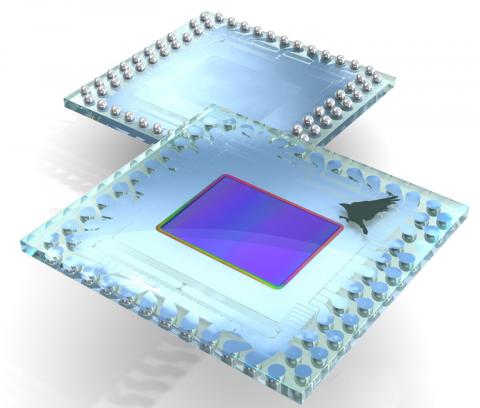
Melexis has introduced the third generation of its automotive image sensors – the MLX75421 Blackbird. This high dynamic range (HDR) sensor has a set of on-chip functional Asil safety support functions.
The device has been architected for automotive safety applications such as automatic emergency braking (AEB), electronic mirrors, camera monitor systems (CMS) and autonomous evasive steering. It is also optimised for next generation viewing applications such as surround and rear view systems with object detection functions.
The support functions are aimed at a cost-effective implementation of Asil. These functions take care of the digital aspects but also cover the sensor’s analogue functions and the sensor interface. As a result, the sensor generates an embedded frame-valid flag for every frame based on run-time self-testing.
“Cost-effective support for Asil systems was a key design specification from the start,” said Cliff De Locht, product marketing manager at Melexis. “For Blackbird’s functional safety design, we drew the company’s internally available functional safety expertise as Melexis already manufactures other Asil ready sensors. This resulted in an impressively smart functional safety design and gives us a head start in targeting safety systems like AEB and other autonomous functions for driverless cars.”
With a resolution of 1344 x 1008 pixels, the device has a four stabilised knee-point HDR response curve that provides up to 125dB of HDR inside every frame. The HDR full frame rate is 45fps, while 60fps can be achieved when capturing image data from 800 rows. This makes the image sensor also compatible with 720p applications. The device runs automatically in HDR mode without the need for a companion chip.
Designed for low noise operation, it has a dark leakage of less than five electrons/s at 25˚C and dark temporal noise of less than 4.4 electrons for a 1/30s exposure time. This results in an SNR1 illuminance value of 0.005 lux for light with a wavelength of 535nm over a 1/30s exposure time.
“For almost every automotive camera function, car manufacturers and their technology partners are telling us that they need markedly improved low-light performance on what is currently available from image sensor suppliers,” said De Locht. “Drivers who have earlier generation camera systems in their cars generally want to see more at night. Also upcoming NCap five-star car ratings are expected to include night conditions for pedestrian and bicycle detection. That’s why we made camera sensitivity and low noise design paramount when developing the Blackbird series. The result is best in class low-light and HDR behaviour.”
There are four versions – monochrome, RCCC, colour RGBG and colour RGBC. Production is planned to start in early 2015. Operating temperature is -40 to +115˚C.
