Semiconductor suppliers get direct access to car makers
Car manufacturers are speaking directly with semiconductor suppliers rather than with tier ones as they strive get the latest features into their vehicles, according to Hervé Branquart, director of automotive at On Semiconductor.
“About 80% of innovation in cars is enabled by semiconductors,” he said, “so they need us to innovate. It is not just microcontrollers. In the past, only the microcontroller makers have dealt with the OEMs but now we are interacting about power products.”
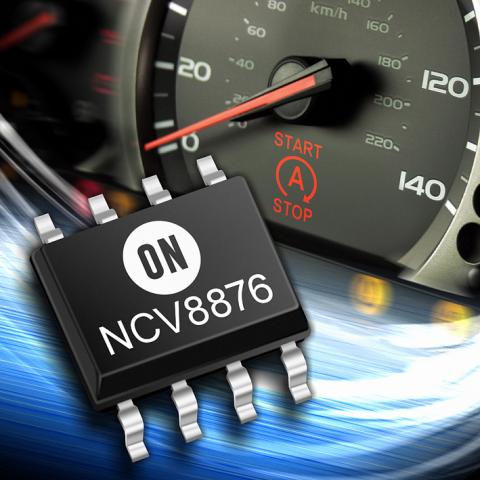
He was speaking at the launch of two AEC-qualified ICs for automotive powertrain and in-cabin applications. The NCV8876 is a non-synchronous boost controller and the NCV896530 is a step-down DC-DC converter.
Running off a 2 to 44V input, the NCV8876 with automatic wake up and shutdown functions is designed to supply a minimum output voltage during start-stop conditions to counteract any sag in the vehicle’s battery voltage. It is enabled when the supply voltage drops below 7.2V, then boost operation is initiated once this voltage goes under 6.8V, with the IC driving an external n-channel mosfet.
A quiescent current of 11µA is drawn when the device is in sleep mode so that power consumption is reduced. Among its array of protection features are cycle-by-cycle current limiting, thermal shutdown (with a +170˚C threshold) and hiccough-mode over-current protection.
Its peak current mode control with internal slope compensation ensures device stability over the entire voltage range. This also ensures that it is protected during a current fault condition by turning off the power switch for the remainder of the cycle if the current limit is exceeded.
The dual-channel NCV896530 has a 2.1MHz switching frequency and is targeted at driver assistance systems. Both of its channels are externally adjustable (covering 0.9 to 3.3V) and can source currents up to 1600mA.
Synchronous rectification enables the device to offer enhanced system efficiency. Inclusion of features such as integrated soft-start, cycle-by-cycle current limit and thermal shutdown protection means this device is optimised for deployment in harsh automotive environments.
Both devices support a junction temperature range of -40 to +150˚C.
The NCV8876 is offered in a soic-8 package and the NCV896530 in a DFN-10 package.
• On Semiconductor has set up a plant in Belgium to act as a pilot line for its proposed gallium nitride (GaN) technology, which it expects will be used for products by 2016.
“GaN gives car manufacturers the opportunity to decrease the cost of the powertrain,” said Branquart. “That is one of the benefits. It has a better RDS(on) and you can make smaller devices, which reduces the cost.”
