Renesas development environment for cruise control in autonomous cars
Renesas Electronics has announced an RH850 multicore model-based development environment. Tentatively named Embedded Target for RH850 Multicore, it is development software for the company’s RH850 multicore microcontrollers designed to simplify the implementation of complex cruise control for autonomous driving.
With rising expectations for autonomous-driving systems as the year 2020 approaches, there is a need for precision combined and coordinated control by multiple high-functionality ECUs to realise quick recognition, delay-free judgement and operation, and precise adaptive cruise control (ACC). To address these needs, it is expected that multicore MCUs that provide high processing performance and low-power performance are required. On the other hand, model-based development (MBD) is being adopted for complex and enormous software development, however there was no support for multicore software implementation design such as code parallelisation and core assignment.
Against this background, Renesas has developed the RH850 MBD that enables automating the multicore software implementation design, confirming its functionality and performance during the early stage of the MBD, and increasing performance of the multicore MCUs.
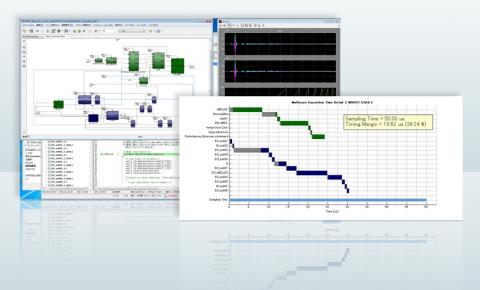
The RH850 MBD automatically searches the optimum core assignments for the control models, and can generate parallel code for multicore MCU and a processor-in-the-loop simulation (PILS) environment in several tens of seconds. Among other features, it can also display the execution state of each core, broken down by subsystem. By using the RH850 MBD, developers can reduce the total development period to approximately one-tenth of what used be required when tasks such as core assignment and parallel source code generation and verification had to be performed manually.
The RH850 MBD interoperates with the eSol MBP RH850 PILS package, an optional product based on the model based paralleliser (eSol MBP) model based parallelising tool from eSol, to search automatically for optimum core assignments based on execution times obtained from a PILS environment running on a single core. This makes it possible to compare, directly in a Matlab and Simulink model, software configurations that efficiently use multicore performance capacity.
Inter-core synchronisation blocks and PILS communications blocks are arranged automatically within a model, according to a core assignment plan from the model based parallelising tool or an assignment plan designated by the user, and parallel source code for the RH850 is generated by Embedded Coder from MathWorks.
At the same time, within the multicore PILS environment, which is constructed automatically, it is possible to confirm at the modelling stage the characteristic performance deviation caused by parallel operation on a multicore architecture. This allows system manufacturers to avoid backtracking in the latter stages of development and helps reduce the time required to develop mass production code.
The debugger functions of Renesas’ integrated development environment, CS+, can acquire simulated execution times for individual subsystems and show a graphical display of the execution status of each core. This makes it possible to check the processing margin available in the step corresponding to the worst execution times in the simulation.
The RH850 MBD automatically generates RH850 multicore parallel code in the implementation phase from the Simulink model and, via a development sequence including function and performance verification, contributes to the realisation of advanced autonomous-driving control systems providing improved fuel economy for green vehicles as well as enhanced safety.
The RH850 MBD will be available from autumn this year. It incorporates the results of R&D work conducted by Renesas with support from the Strategic Innovation Programme for Energy Conservation Technologies of the New Energy & Industrial Technology Development Organisation (NEDO), and its practical implementation is the result of joint research with the Parallel & Distributed Systems Lab at Nagoya University.
