Renesas targets R-Car SoC at 3D instrument clusters
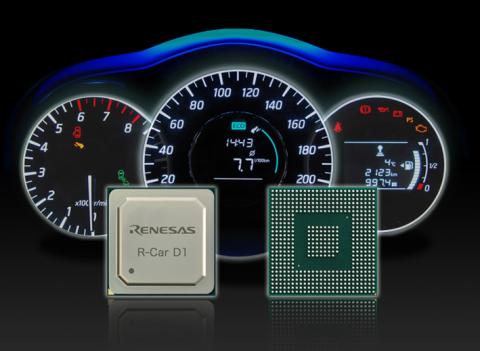
The R-Car D1 series from Renesas is the first SoC in the R-Car family specialised for 3D instrument clusters. The aim is for the series to provide a smooth migration path for automotive manufacturers as more automotive systems are expected to shift to 3D graphics instrument clusters in the near future.
As the use of colour LCD panels in instrument clusters becomes more widespread, gauge control and graphics display are being combined in smaller and medium size cars. The trend towards gauge-less displays is already progressing in high-end cars, where visibility and comfort are desired, and attractive, easy to see displays using 3D graphics on large, high-resolution panels are seen as one aspect of a car's individuality.
In the future, display size and resolution are expected to continue increasing, even in the graphics displays used in low- to mid-end cars, along with the use of clusters that provide 3D graphics similar to that used in high-end cars.
However, for these to become more mainstream, the ability to realise rich reality image displays that make full use of 3D graphics, the ability to display the cluster screen rapidly at the same time as the start-up of accessories, the ability to realise high reliability that can prevent unauthorised access from the outside, to convey accurate information from the instruments continuously to the driver, and the ability to enhance the performance of the many electronic equipment units and communications used in the car will all be required.
The D1 is said to provide both the functionality and the performance to overcome these problems and provide access to the R-Car Consortium ecosystem that consists of more than 170 companies.
Renesas also offers gauge control support through its RH850/D1x microcontrollers (MCUs) that are also for entry-level and mid-range automotive applications.
Although good view-ability and high-quality design are important to improve visibility and comfort in cluster s with full graphics, at the same time, for users with limited experience in 3D graphics development, the time required for development is an impediment. Based on experience developing HMIs, along with partner companies who have expertise in developing graphics, Renesas provides products that can express the images created by a graphics designer as a cluster. This makes it easier for manufacturers to develop their own 3D clusters.
Instrument clusters require a rapid start-up so that, for instance, immediately after the driver opens the driver's side door, or at the same time accessories are starting up, the cluster can instantly display the screen or output audio run at high speed. The R-Car ecosystem provides products that support high-speed start-up, rapid display of meter and gauge screens, and audio output.
Since instrument clusters may cause serious accidents should they malfunction, it is desirable that, to provide the driver with correct information, they continuously monitor whether or not correct information is being output and, should a malfunction occur, the malfunction needs to be immediately detected. To implement high-reliability, the D1 supports the ISO 26262 standard for automotive functional safety. Renesas also provides a support programme to implement functionally safety.
Furthermore, since it is necessary to prevent hacking from outside, the RH850 32bit MCU that includes hardware security functions can be combined with the D1. This makes it possible to construct systems that assure data robustness and prevent hacking.
The D1 includes communications interfaces required in an instrument cluster. This includes Ethernet AVB for connection with navigation products, USB to connect with smart phones, and Can-FD to connect with automotive infotainment systems.
The RH850/D1M group of MCUs can implement both gauge control and 2D graphics display with a single chip and is already used in a wide range of cars. Since the D1 SoC includes the same 2D graphics as that used in the RH850/D1M, manufacturers can make use of these 2D graphics development assets, and develop 3D graphics for the D1. Also, if gauge control is required, manufacturers can also combine the D1 with the RH850/D1M.
Samples of the D1 are available now. Mass production is scheduled to begin in March 2017 and is expected to reach a volume of 100,000 units per month by March 2018.
