Toshiba analogue output photocoupler targets EVs
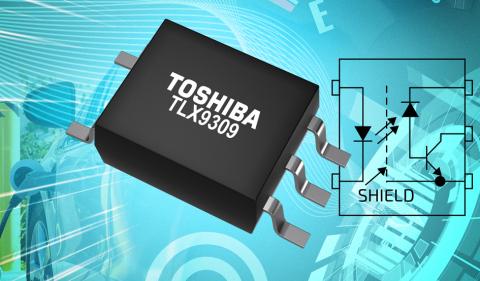
An analogue output IC photocoupler from Toshiba Electronics enables high-speed communications in automotive applications, especially electric and hybrid electric vehicles.
The TLX9309 consists of a high-output GaAlAs LED that is optically coupled to a high-speed detector. The detector consists of a photodiode and a transistor integrated on one chip. A Faraday shield has been integrated onto the photodetector chip to provide enhanced levels of common-mode transient immunity, typically up to 15kV/μs, an important parameter in electrically noisy automotive environments.
By separating the photodiode and amplification transistor, the collector capacitance is reduced, reducing propagation delays and making the open-collector device faster than transistor output devices. In fact, propagation delay times are guaranteed to be between 0.1 and 1.0μs, with the difference between high to low and low to high transition being no more than 0.7μs, making the device suitable for high-speed communications such as inverter control or as an interface to intelligent power modules.
Electrically, the device offers 3750Vrms of isolation with 5.0mm creepage and clearance for safety isolation. It operates from a supply in the range -0.5 to +30V DC and can drive up to 25mA at output voltages up to 20V. The current transfer ratio is in the range 15 to 300%.
The device is packaged in a 3.7 by 7.0 by 2.2mm RoHS compliant five-pin SO6 package and operates over the temperature range -40 to +125˚C. It is AEC-Q101 qualified for use in automotive applications, and is in mass production.
