Test & Measurement: Grasping the wireless nettle
John Russell and Bill Mckinley from Keysight and Matt Hodgetts from Microlease discuss the test implications arising from the advent of connected cars
The technological sophistication of modern automobiles means they are very different from the models of the past. In many areas conventional mechanical systems have been replaced by sophisticated electronics. This is allowing improvements in operational efficiency, as well as enabling a wider range of features and functionality from which to benefit.
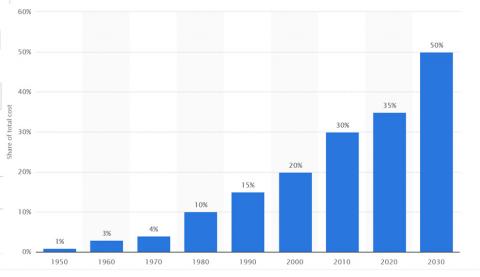
In many ways the cars that are being introduced onto the market today have much more in common with computing devices than they do with their predecessors. They will, in some cases, need to process in excess of 25Gbyte of data per hour to fulfil all their assigned tasks. The graph illustrates how the percentage that the electronics content contributes to the total cost of a car has risen over the decades, and it is expected to keep rising.
Until now, the impetus for implementing digital technology into automotive designs has been mainly for the purpose of eliminating mechanical elements. Through this, marked reductions in vehicle weight are being witnessed, leading to a significant boost in fuel economy. This is just one dimension, however, and there are a multitude of other roles it could potentially perform that are being investigated in earnest, such as enhancing the overall driving experience, keeping vehicle occupants away from potential harm and providing better connectivity with the outside world.
Vehicles manufacturers are moving ever closer to their goal of the connected car. Such vehicles will integrate systems supporting a broad array of different communications technologies, and through these it will be possible to address issues relating to driver and passenger comfort and safety, as well as vehicle security. It will also make it easier to ensure the vehicle is kept in good working order and that maintenance and repair requirements are identified in a timely manner.
Industry analyst Gartner has forecast that by 2020 there will be over 250 million connected cars on our roads. These vehicles will employ numerous different wireless protocols such as wlan, LTE, Bluetooth, NFC and Zigbee. This presents vehicle manufacturers and their technology partners with a sizeable and multifaceted challenge. Not only do they need to derive an accurate benchmark of each of these protocols in isolation, they must also gain a firm grasp of how the wireless signals will interact with one another and what influence the extremely difficult automotive environment in which they are located is likely to have on performance.
Connectivity
There are several parts of a vehicle’s operation where the heightened degree of connectivity now envisaged is destined to have real value, such as infotainment, communications, telematics and adas.
Infotainment and communications developments mean the connectivity that people take for granted in every other aspect of their daily lives will be available to them inside their cars too. Smartphones will be wirelessly hooked up to the vehicle, allowing hands free operation to be initiated and the sharing of multimedia materials. Likewise, other portable electronics devices such as tablets could be used by passengers in the backseats to connect to the internet and download music, stream videos or engage with social media.
Telematics will cover a broad range of tasks that need to be executed by the vehicle. Already data are transmitted wirelessly for tyre pressure monitoring usually via Zigbee and remote keyless entry to vehicles through ISM bands. This is helping keep down the cost and weight associated with cable harnessing. Moving forward, it will not only be aimed at benefiting the driver and passenger. Gaining access to telematics data will enable fleet tracking and prevent theft. It will also mean insurance companies can assess the circumstances that led to an accident. And it will enable the transfer of information regarding on-board diagnostics so servicing can be carried out more effectively.
Adas technology being incorporated into vehicles is slowly moving us closer towards fully autonomous vehicles. Vehicle radar is enabling collision avoidance and lane change assistance mechanisms to be taken advantage of. Through vehicle-to-vehicle (V2V) and vehicle-to-infrastructure (V2I) communications, valuable data will be transferred wirelessly between vehicles relatively close to one another as well as with traffic lights, speed signs and so on, pertaining to possible road hazards, congestion problems and suchlike. Functionality of this kind will reduce driver frustration and increase the safety of vehicle occupants. In the USA, the National Highway Traffic Safety Administration is putting legislative measures in place that will mean all new cars and trucks being produced will need to include V2V technology.
Leading vehicle brands, of course, want to provide car buyers with all the extra capabilities that have been outlined, but given the highly competitive market they need to do this in a way that doesn’t bring excessive additional costs. It is crucial, therefore, that testing activities do not slow down the production process or require allocation of extra engineering resources.
Test requirements
Though in the telecoms sector, data rates are the overriding concern, for connected cars it will be low latency and elevated reliability that matter. Through the test equipment they have sourced, engineers need not only to verify performance of the automotive wireless technologies being used, but also carry out comprehensive interference and interoperability tests. So, in addition to rapid throughput, a breadth of test parameters is basically mandatory.
Scalability is also of great importance. Testing within a laboratory is just the beginning. The product lifecycle as a whole has to be adequately attended to, not just isolated elements. Once the necessary tests have been accomplished during the development phases, these activities need to be ramped up to meet mass production demands. It is important that the specified equipment can deal with this migration.
802.11p
The 802.11p standard is set to form the foundation on which much of the functionality in connected cars will be constructed. This is an approved amendment to the universally recognised 802.11 wlan standard. It deals with wireless access inside an automotive setting and will support intelligent transportation system (ITS) applications as they start to emerge.
Occupying the 5.9GHz frequency band, 802.11p uses a series of 10MHz wide channels – six service channels, plus an addition channel for control purposes. The priority with this protocol is not offering a high data capacity, it is about establishing a highly reliable, low latency wireless data link.
This more deterministic technology will make it possible for V2V and V2I communications to be implemented. A vehicle will be able to broadcast data relating to its current position and the speed and direction in which it is travelling. These data may then be picked up and, if necessary, acted upon by other vehicles in the vicinity.
John Russell and Bill Mckinley are from Keysight and Matt Hodgetts works for Microlease
