Connected car market to grow at 32% CAGR, says Technavio
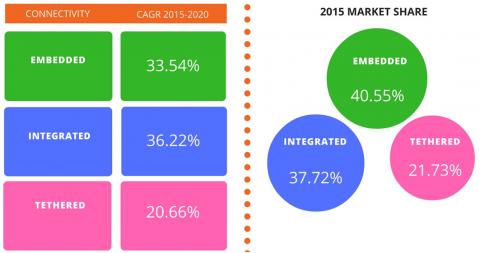
The global connected car market is expected to reach US$145bn by 2020, growing at a progressive CAGR of more than 32 per cent, according to a market study by Technavio.
The demand for in-vehicle connectivity and telematics has led to technological improvements, which aim at enhancing the overall in-vehicle experience of passengers and drivers. As a growing number of consumers have increased the amount of time spent on their personal mobile devices, they expected the same experience from their in-vehicle entertainment and information systems, especially with respect to user interface.
The report – Global Connected Car Market 2016-2020 – provides an analysis of the market in terms of revenue and emerging market trends. To calculate the market size, the report considers the revenue from the connected car technologies across all regions.
Analysts have categorised the global connected car market into three major segments by connectivity type. These are embedded, integrated and tethered products.
Embedded
Automobile OEMs have been trying to establish maximum control points in the global connected car market. They have been employing business models to grab the centre stage of the connected car ecosystem. Hence, there has been a rise in collaborations between OEMs and other players in the global connected car market to encourage adoption of embedded products.
“The luxury car segment will register high adoption of embedded as cost is not a parameter for this segment, and these OEMs create differentiation for their product by developing the unique system for their models,” said Neelam Barua, a lead automotive electronics analyst from Technavio.
Integrated
Smartphone penetration across the world has risen significantly in the recent past, and it is expected to grow further thus driving the need for integrating them with the vehicle systems. It is estimated that the global smartphone penetration was about 25 per cent in 2015 and it is expected to reach 38 per cent by 2020. As a result, there has been a rise in demand for high resolution HMIs, which can be integrated with smartphones.
“Consumers prefer availability of a strong application base for their connected devices,” said Neelam. “For instance, the Android operating system for smartphones has the highest number of users in the market owing to its support for an array of third-party applications.”
Tethered
Tethered products such as Mercedes Command use mobile phones for connectivity, and run the apps on the in-car infotainment instead of smartphones. Apple Carplay and Android Auto are the prominent players in the tethering technology, and their growing adoption across vehicles is a positive trend for the tethering segment of the global connected car market.
MirrorLink is another tethering product that allows smartphone compatible. With MirrorLink, the user can power the car’s digital display and this makes it a low-cost alternative to embedded products. Hence, this segment is expected to grow in terms of adoption from developing regions of the world.
The top vendors highlighted by the report are Alpine Electronics, BMW, Delphi Automotive, Ford Motor and NXP Semiconductors.
