Autonomous Vehicle: Humans versus computers
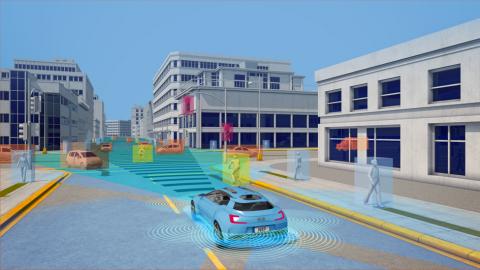
Davide Santo from NXP traces the road towards autonomous vehicles
With OEMs and governments throwing hundreds of millions of dollars into the development of autonomous technology, driverless vehicles are on the way to becoming a reality, and will be arriving soon.
There are already cars on the roads that are able to handle specific tasks without human intervention – with features such as lane assist, parking assist and variable cruise control taking the pressure off drivers – and fully autonomous cars are being put through their paces at test locations around the world.
The current crop of autonomous prototypes are packed full of sensors, with lidar, radar and cameras all playing a big part in helping a vehicle see the world around it. Capturing information about the immediate vicinity and what’s happening around the vehicle is just the start, though, with a host of powerful processors and artificial intelligence (AI) playing a big part in what happens next.
But the question is can AI replace humans as drivers completely?
Vision on
Once the various sensors provide data, an autonomous vehicle needs to pick the best course of action based on the information at its disposal, without any input from humans. Vehicles can do this using two different types of intelligence: machine vision and computing vision.
Machine vision creates automatic functions based on the analysis of images, having used notable characteristics to estimate properties including motion, distance and other information. It’s clever, but computing vision is possibly better suited to playing the role of a human, instead analysing data to extract knowledge before making a decision. It means cars will be able to classify an object, work out its distance and a point of collision, making a reliable, dependable and safe choice on how to react.
To do this, autonomous cars need to learn the same way a human would, and this is where there are big differences between AI and human intelligence. AI is able to extract information and classify objects before making predictions, but there’s still scope for error in those predictions, and because it is not always known exactly why AI reacts the way it does, correcting the behaviour of machines could prove difficult. Both humans and AI can learn from those errors, but it’s a lot easier ascertaining why a human responded in a particular way.
There are plenty of benefits that machines can offer, such as the ability to use radar to see around objects, to see 360 degrees simultaneously using lidar and cameras (something a human could never do), and to be able to process multiple tasks without getting distracted. Perhaps just as importantly, autonomous vehicles will also be able to react to situations near instantly, saving precious time when it could be needed most.
Technology such as V2X also paves the way for autonomous driving by allowing vehicles to exchange information with other vehicles and infrastructure systems enabling them to react 25 times faster than a human would.
With near instant reactions, the ability to communicate with other vehicles and to see far more than humans ever could, autonomous cars have a lot of tricks up their sleeves, but they’re still fallible. For example, it will be near impossible for a machine to learn to drive as a human, as machines will always lack the initiative humans naturally possess.
That’s a good thing when it comes to less desirable traits – you’ll never see an autonomous car intentionally taking its eyes off the road – but it also remains to be seen how machines will respond to unusual situations. If an accident is inevitable how will AI prioritise which objects to hit and which ones to miss?
There’s also a big difference in learning processes, with most humans taking an almost intuitive approach to driving, learning mainly by trial, error and experience. Autonomous cars need to be taught how to react to different situations – from avoiding pedestrians to deciding what to do if an animal runs in front of the car, and it’s vital that OEMs get this bit right if autonomous cars are going to drive on public roads in a safe and predictable manner.
While autonomous cars may be the future, we won’t be seeing the disappearance of human drivers just yet, as machines still have a lot to learn and will never be able to replace the initiative humans naturally retain. In the meantime, however, technology can help provide the best of both worlds, with cars using the likes of radar and cameras to alert drivers of dangers that haven’t been spotted, taking over in the event of emergency or automatically applying the brakes. Could that be the perfect balance?
Davide Santo is global adas microcontroller manager at NXP
