Power technologies: Lab work
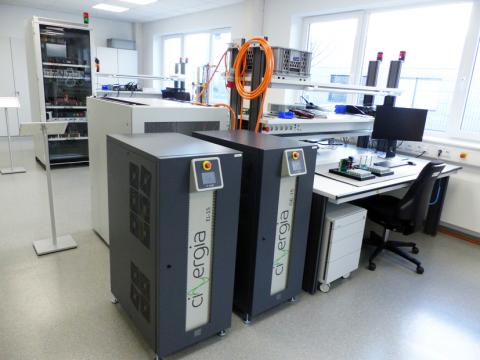
Steve Rogerson visits Rohm Semiconductor’s recently opened European Power Lab
With increases in complexity and growing pressures on time to market, the life of the automotive electronics engineer is becoming harder. On top of that, the wide variety of applications in which semiconductor components have to be used means that traditional datasheets often do not cover every possible use case.
The result is that both car makers and their suppliers have to work more closely with the component makers throughout the design stage.
This was the thinking behind Japanese company Rohm Semiconductor opening its Power Lab testing laboratory at its European headquarters at Willich near Dusseldorf in Germany late last year.
“Engineers are facing a lot of challenges,” said Aly Mashaly, manager for power systems at Rohm Semiconductor. “It is a lot more complex, they have limited resources and little time. They want to find the easiest way to design their circuits, they need better data and they need evaluation boards because there is no time to test new devices.”
For example, one the biggest challenges engineers face is thermal management. Here is where the difference between the datasheet and the application really stands out.
“The semiconductor suppliers cannot cover every application,” said Mashaly, who is also head of the new laboratory. “There will be points in the final application that are not covered in the datasheet. Power semiconductors are used in different applications with different loads. They are also used everywhere in the world, so environmental conditions and grid performance have to be considered.”
To help engineers tackle these problems, Rohm decided to provide local technical support at the application level in Europe, and so the Power Lab was born. The engineers employed there will look at how its customers are using the devices and provide support for them through all phases of the project with the focus being at the system rather than component level.
“We can perform special tests for a customer at the application level,” said Mashaly. “With the Power Lab, we can show how the parts work together.”
The 300m² lab's purpose is the analysis of power components and systems to provide support at the application level. To that end, it is equipped with several test benches with a separate high-voltage area.
“We set up test benches with state-of-the-art technologies,” said Mashaly.
The power test bench enables tests on AC-DC, DC-DC, DC-AC and AC-AC converters under real application conditions up to 15kVA. Additionally, precision measurements of efficiency and losses can be performed with power analysers. Among this test bench's special features are an AC power supply (grid emulator) and AC and DC electronic loads. Maximum voltages under test are 1500V DC and 400V AC.
The calorimetric test bench is for analysing the thermal behaviour of the power discrete devices, modules, electronic boards and complete power electronics systems. This test bench can test at very high current supplies with hundreds of amps and has a climatic chamber for tests under special temperature conditions from -40 to +180˚C. Humidity can be set between 10 and 98%.
The high-voltage test bench for voltages up to 8kV is in a separate room to protect the tester during the operation.
The lab can also investigate and test the insulation sections – so-called clearance and creepage distances – on board and at system level up to 6kV.
“We designed the test benches ourselves,” said Mashaly. “This ensures the quality and it also makes it easier to make modifications in the future.”
Formula E
One company that has benefitted from the way Rohm likes to work closely with its customers is Formula E team Venturi. The company has been the official technology partner of the racing team since the 2016-17 season and the team’s engineers have been using Rohm’s silicon carbide (SiC) power devices to improve the effectiveness of the power electronics.
“We are pushing all the components to the limit and beyond the limit,” said Franck Baldet, CTO for Venturi.
To do this, he said, it was important for the team to work closely with its suppliers.
“It is a technology partnership we have with Rohm,” he said. “Rohm produces the power modules that have to be integrated and that process can involve redesigning the modules. It is team work. We perform all the tests together. If we find weaker points, then Rohm works hard to solve the problems. That is why we end up with reliable parts.”
Conclusion
The speed of innovation in the automotive world is the main driver for companies such as Rohm to set up these types of facilities to help customers integrate the devices that they supply. And this is a situation that is going to be amplified as more automation and hence more electronics are integrated into vehicles.
“Within less than ten years we will have autonomous driving,” said Christian André, president for Rohm in Europe, “ though the driver will still have the choice of whether to use this or not.”
This time frame will also see an increase the electrification of vehicles as car makers strive to meet ever more stringent emissions regulations.
“The electric vehicle market is being driven by lower emission targets,” said André.
However, he said drivers had their own expectations, the top one being the technology had to be affordable. The design also has to be good. They have to be easy to recharge and be able to do this anywhere.
“Customer curiosity is growing but product availability is limited,” said André.
From a technology point of view, there is a requirement for more power density. Components have to work at high temperatures. They have to be lighter and compact. Electric vehicles must have a driving range up to 500km and there has to be a fast charging infrastructure.
He said Rohm was well placed to meet these challenges and as such was seeing an increase in automotive revenue, which accounted for just 11% in 2004 but was now nearly a third of the company’s revenue.
“By the end of 2021, the target is 35% of revenue in automotive,” he said. “But we also have to balance our revenue geographically. We want our business outside of Japan to grow from 40% currently to 50%.”
The company thus has an investment plan to spend $540m to increase its overseas revenue including building a new plant for resistors, capacitors and, later, transistors in the Philippines and increasing capacity in Germany. To do this, it also needs to work more closely with its customers and the Power Lab is an important step to achieving that goal.
