Power Technologies: Emergency power
Theju Bernard, principal applications engineer for Renesas Electronics, explains how to improve automobile battery life with the right chemistry
The automotive industry is quickly moving towards more electrification. The deployment of start-stop systems, emergency call (ecall) telematics and hybrid vehicles is fuelling the need for advanced battery management systems that not only charge the battery in a safe manner but also prolong its useful life.
There are many battery chemistries available in the market today, which makes the selection decision more difficult when trying to pick the right one for a particular application, along with a suitable charging option.
The Li-ion battery is a rechargeable battery where lithium ions move from the negative electrode to the positive electrode during discharge and back when charging. They use an intercalated lithium compound as electrode material. The electrolyte, which allows for ionic movement, and the two electrodes are the fundamental components of a Li-ion battery cell. Generally, Li-ion batteries have high energy, but low power.
The charging profile of a Li-ion battery has a nominal voltage of 3.6V with an upper charge cut-off voltage of 4.1V and a lower charge cut-off voltage of 2.2V. Li-ion cells must be charged precisely according to vendor recommendations to ensure reliability and safety. There are typically restrictions on charging the cell outside of the specified levels and outside of a recommended temperature range.
Between the lower and upper voltage levels, the charge current is typically recommended to be held constant and should be limited to the vendor recommended level to prevent battery damage.
Below the lower charge cut-off voltage, the battery should be charged with a very low current, typically ten per cent or less of the current used between the lower and upper voltage levels. This is often referred to as pre-charging the battery and is recommended for deeply depleted batteries. Some materials within the battery may degrade if it endures a prolonged state of deep discharge.
Pre-charging is recommended to allow these materials to recover. Pre-charging is also a precaution that will prevent overheating in case the battery experienced an internal short circuit that led to the low cell voltage.
Charging the battery above the maximum charging voltage is also detrimental to the battery life. Short periods of overcharging can degrade the materials within the battery and lead to reduced energy capacity and a shorter lifetime. Extended periods of overcharging will cause metallic lithium to be plated on the anode while the cathode releases CO2. This process can ultimately result in battery failure and a catastrophic combustion event.
Additionally, to increase battery life, battery manufacturers often stipulate that the charging be performed within a limited temperature range. Charging most Li-ion battery technologies below freezing can cause metallic lithium to be plated on the anode. This is detrimental to battery life, as the plated lithium cannot be removed. Exposing the battery to elevated temperatures when charging also reduces battery life. Cycling a Li-ion battery between 0 and 100 per cent of full charge only a few times at elevated temperature can drastically reduce its capacity. In some cases, battery capacity can be reduced by more than 90 per cent.
A simple way to achieve the vendor’s recommended charging profile is to use a dedicated charger that can perform the quickest charge in the safest manner. This can allow a programmable constant charging current and can come pre-programmed with upper and lower charge cut-off levels that are suitable for most traditional Li-ion batteries. A cell temperature monitor can ensure that the battery is only charged within a temperature range that is programmable with an NTC thermistor.
Lithium iron phosphate
The LFP battery is a type of rechargeable battery that uses a nanoscale LiFePO4 material as a cathode. LFP batteries have lower energy density than other lithium batteries designed for use in consumer electronics; however, they have longer lifetimes, better power density and are inherently safer.
The nano phosphate technology used in the cathode helps increase the cathode’s surface area exposed to the electrolyte. This allows faster lithium insertion resulting in more power and a higher current rating. This feature makes LFP a popular choice for replacing automotive starter batteries, where high peak power is needed.
LFP battery materials and the associated chemical reactions are also inherently more stable than other Li-ion chemistries, so it is not often that LFP batteries are damaged if mishandled or misused. The chemical bonds within the battery materials are stronger, making them more stable and resistant to extreme conditions. They are also less likely to release gasses when overcharged and therefore less likely to experience the phenomenon called vent with flame.
Their inherent robustness makes them an attractive option for small backup batteries in applications where safety concerns are front and centre. Many vehicle component makers cite this as a principal reason that LFP cells are frequently chosen for automotive applications.
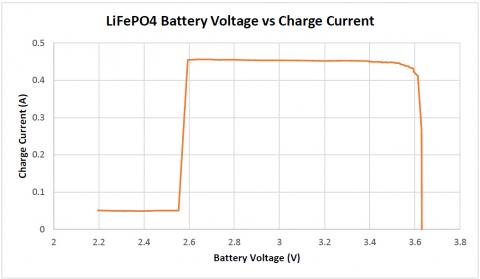
The diagram shows the recommended charging profile of an LFP battery. It is very similar to that of a Li-ion cell; however, the safe charging range is at different cell voltages. It has a nominal float voltage of 3.2V with an upper charge cut-off voltage of 3.65V and a lower charge cut-off voltage of 2.5V.
As with Li-ion batteries, charging an LFP outside of the vendor defined upper and lower charge thresholds can still be detrimental to battery life, although to a much less extent. Between these levels, the charge current should be held constant within the range recommended for the particular cell. In this case, the vendor has recommended a current between 400 and 500mA for maximum battery life. And similar to Li-ion batteries, charging should be performed within the stipulated temperature range.
Since consumer electronics have typically favoured Li-ion over LFP batteries for their higher energy density, there have traditionally been fewer dedicated charging products for LFP cells. However, given the recent adoption of LFP in automotive applications, new LFP chargers are being introduced. They provide an easy way to achieve the recommended charging profile for LFP batteries.
For example, a single-cell LiFePO4 battery charger for automotive ecall systems can be configured to provide the charging profile shown in the diagram, and can have built-in features to ensure the battery is charged in a safe manner.
Conclusion
The on-going electrification of automobiles provides designers with an entirely new set of selection criteria, starting with the battery chemistry’s end application. While the charging profile of an LFP battery is very similar to that of a Li-ion cell, the safe charging range is at different cell voltages.
Car makers worldwide are installing ecall in their vehicle to infrastructure systems. In the event of a crash, the ecall system automatically broadcasts its location via GPS and contacts the nearest 24-hour emergency call centre for help.
Because of the inherent robustness of LFP batteries, they are an attractive option for small backup battery ecall applications where safety concerns are important. Many vehicle component makers cite this as a principal reason that LFP cells are frequently chosen for this application.
Theju Bernard is a principal applications engineer for Renesas Electronics
