Loughborough University looks at the effects of roadworks on autonomous vehicles
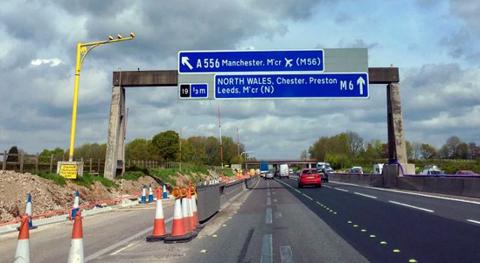
A £1m project will see Loughborough University in the UK team up with Highways England to look at the effects of roadworks on the ability of connected and autonomous vehicles (CAVs) to navigate motorways.
Researchers will look at operations at roadworks, merging and diverging sections across lanes and at junctions, and lane markings to understand the problems CAVs may face.
The project, named Caviar (Connected & Autonomous Vehicles: Infrastructure Appraisal Readiness), is being carried out in partnership with construction company, Galliford Try. Caviar was announced as a winner in Highways England’s innovation and air quality competition last year and awarded £1m from the government innovation and modernisation fund.
The UK government and industry are investing heavily in CAV technology to attain a competitive advantage in the future market for mobility systems.
The ability of CAVs to operate fully autonomously may not be entirely contained within the vehicle technology due to the inherent complexity in the roadway infrastructure. In addition, weather conditions may limit the ability of on-board sensors to detect road markings, configurations, traffic and road conditions.
“To date, there is significant investment and advancement in connected and autonomous vehicles,” said Mohammed Quddus, professor of intelligent transport systems at the university and principal investigator on the project. “It is, however, not known whether existing road infrastructure, which was designed for conventional vehicles, is ready for the safe and efficient operations of CAVs. Caviar directly addresses this challenge. Although CAVs are designed with existing infrastructure in mind, ensuring they are safe to operate on motorways will require evaluating how road layouts affects their operational boundaries such as their ability to sense lanes and make appropriate decisions.”
The platform will be employed to evaluate whether CAVs can safely navigate through the existing configurations of construction zones. Real-world data from different lane configurations will be collected and fed into the simulation models to calibrate and examine how CAVs respond to dynamic lane changes. Digital maps representing dynamic lane configurations will be transmitted to CAVs in advance for informed routing decisions.
In terms of lane markings, the platform will be used to understand how environmental conditions affect a CAV’s ability to detect lane markings, such as snow and low lighting such as at night.
For merging and diverging scenarios, inconsistencies in geometric configurations will be appraised to examine whether CAVs can merge safely from the local road network (low speed) to the motorway network (high speed).
The team from the university’s School of Architecture, Building & Civil Engineering (ABCE), led by Quddus, also includes Craig Morton, Alkis Papadoulis, Nicolette Formosa, Cansu Masera and Jacky Man.
Loughborough will lead the work on the development and validation of the simulation platform.
“Our vision is to deliver a world-leading experimental and simulated platform for assessing motorway infrastructure readiness level for CAV operations underpinned by the sciences of AI, statistics, optimisation and verification to realise the UK government target of having self-driving vehicles on UK roads by 2021,” said Quddus. “We will instrument a vehicle with a plethora of sensors including lidar, radars, cameras, GPS and V2X communication facility to collect real-world motorway operational data and integrate them with midas (motorway incident detection and automatic signalling) data to validate and verify the simulation platform in evaluating different aspects of CAV infrastructure readiness.”
The team will collect data about the flow and configuration of the traffic throughout different lane structures, junction layouts and stretches of roadworks via lidar, radars, cameras, GPS and other instruments.
“These data will allow us to evaluate whether a CAV can navigate these situations by conducting a series of controlled experiments at an off-road test facility,” said co-investigator Morton.
Caviar objectives are: to instrument infrastructure and vehicle for acquiring relevant data; to create a centralised data integration architecture; to build simulation models for CAV failure scenarios; to verify the experimental and simulation platform by feeding data from live trials to the simulation models and vice versa; and to appraise motorway readiness level for safe and efficient CAV operations.
“We are delighted to be partnering with Loughborough University on the Caviar project,” said Jon de Souza, of Galliford Try. “The ABCE team bring market leading expertise which will support the delivery of a project which will significantly further our understanding of the implications for highway infrastructure on a future increase in the quantity of connected and autonomous vehicles on the strategic road network. The recommendations from Caviar will support contractors such as Galliford Try to improve their offer as well as supporting highways operators to make better long-term capital and operational investment decisions.”
John Mathewson, senior ITS advisor of Highways England, added: “Our fund is all about stimulating innovation and supporting research and trials to ensure the UK remains ready to adopt cutting edge technology. This research will build on our understanding and give us further insight into how connected and autonomous vehicles would operate on England’s motorways and major A roads and what challenges they may face. It is a great example of partnership working between academia and industry. The results could help us shape how we invest in future road design and maintenance.”
