Renesas hits ISSCC with adas SoCs
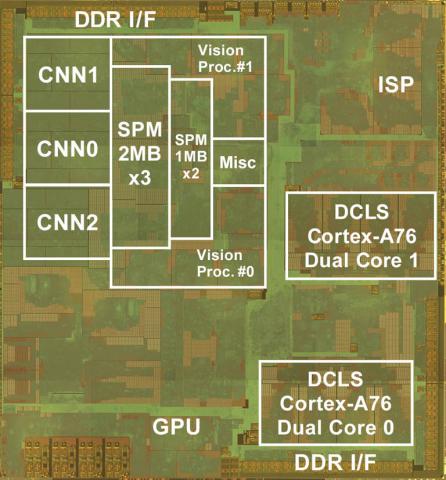
Renesas Electronics presented at this month’s International Solid-State Circuits Conference processor technologies for automotive SoCs used in applications such as adas and autonomous driving.
The systems aim to optimise performance and power efficiency while supporting a high level of functional safety.
The announcements included: a convolutional neural network (CNN) hardware accelerator core that combines a deep learning performance of 60.4Tops and a power efficiency of 13.8Tops/W; safety mechanisms for fast detection of and response to random hardware failures that make it possible to create a power efficient detection mechanism with a high failure detection rate; and a mechanism that allows software tasks with different safety levels to operate in parallel on the SoC without interfering with each other, thereby bolstering functional safety for Asil D control.
These technologies have been applied in the company’s latest R-Car V3U automotive SoC.
Applications such as adas and autonomous driving require deep learning performance of 60 or even 120Tops alongside power efficiency. In addition, since signal processing from object identification to the issuing of control instructions constitutes the bulk of the processing load, achieving the functional safety equivalent to Asil D – the strictest safety level defined in the ISO 26262 automotive safety standard – is a pressing issue.
As the number of sensors used in these systems increases, more powerful CNN processing performance is required. In addition, there is a need to reduce the heat generated by power consumption to make possible ECUs that are air-cooled, which brings advantages in weight and cost.
Renesas has developed a CNN hardware accelerator core with deep learning performance and implemented three such cores, in a high-density configuration, on the R-Car V3U.
In addition, the V3U has 2Mbyte of dedicated memory per CNN accelerator core, for a total of 6Mbyte. This reduces data transfers between external dram and the CNN accelerator by more than 90 per cent and achieved a CNN processing performance of 60.4Tops with power efficiency of 13.8Tops/W.
ISO 26262 specifies numerical targets (metrics) for various functional safety levels. The metrics for Asil D, the highest functional safety level, are 99 per cent or above for the single point fault metric (SPFM) and 90 per cent or above for the latent fault metric (LFM), which means that an extremely high detection rate is required for random hardware failures.
In addition, due to the higher level of involvement in vehicle operation of systems such as adas and autonomous driving, automotive SoCs overall have come to incorporate more functions subject to Asil D requirements.
Renesas has developed safety mechanisms for fast detection of and response to random hardware failures occurring in the SoC overall. Both reduced power consumption and a high failure detection rate are achieved by combining safety mechanisms suited to specific target functions.
The incorporation of these mechanisms into the V3U is expected to bring the majority of the SoC’s signal processing into achieving the Asil D metrics. A SoC that satisfies the Asil D metrics is capable of independent self-diagnosis, and this reduces the complexity of fault tolerant design in an autonomous driving system.
Achieving freedom from interference (FFI) between software tasks is an important aspect of meeting functional safety standards. When software components with different safety levels are present in the system, it is essential to prevent lower-level tasks from causing dependent failures in higher-level tasks.
In addition, an issue of particular importance in SoCs is ensuring FFI when accessing control registers in various hardware modules and shared memory.
Renesas has developed an FFI support mechanism that monitors all data flowing through interconnects in the SoC and blocks unauthorised access between tasks. This enables FFI between all tasks operating on the SoC, making it possible to realise a SoC for Asil D applications capable of managing object identification, sensor fusion with radar or lidar, route planning, and issuing of control instructions with a single chip.
